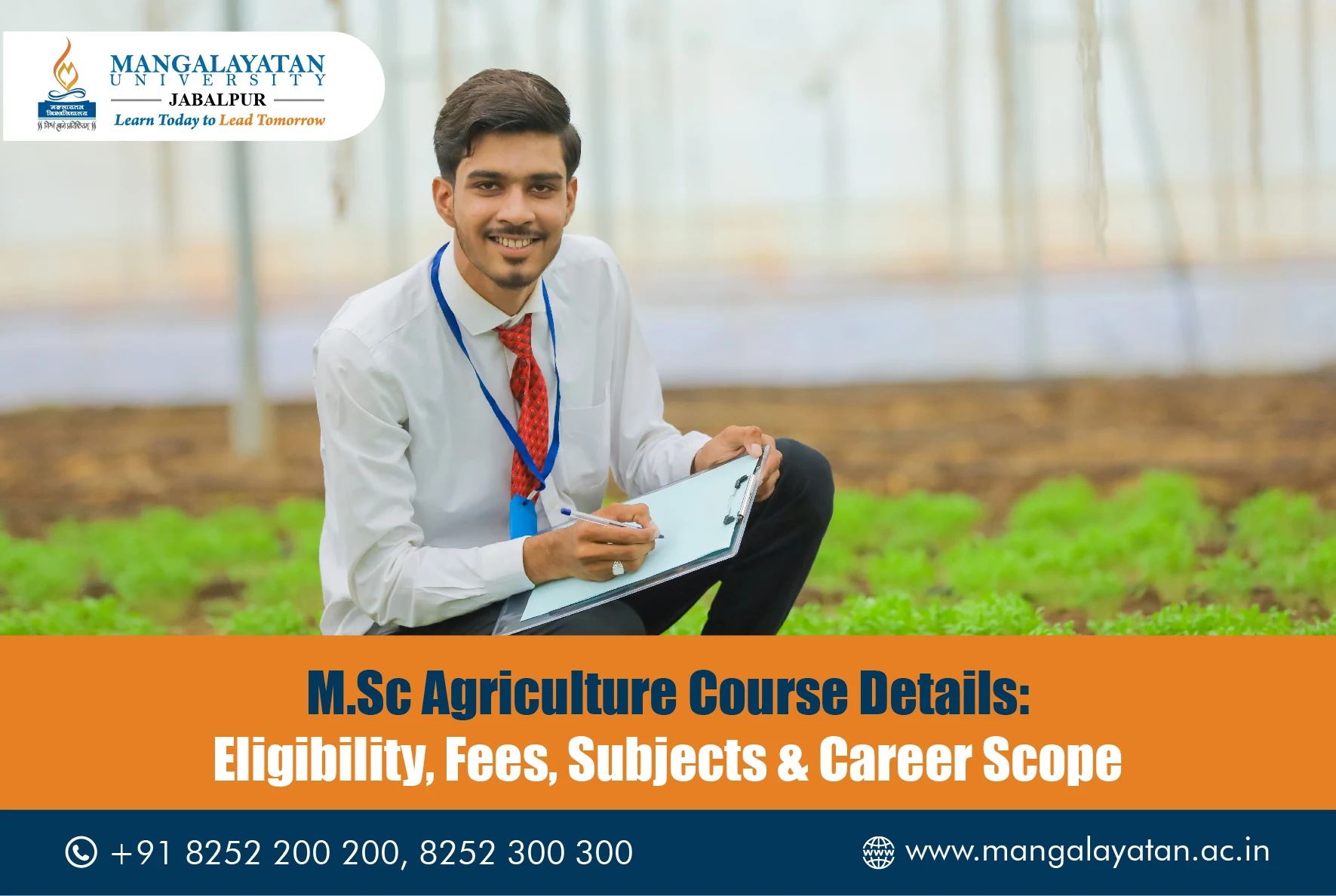
M.Sc. Agriculture Course Details: Eligibility, Fees, Subjects & Career Scope
Do you have a love for agriculture and crop production and are interested in soil science and technologies of modern farming? Do you wish to create a great career in the field of agriculture and help secure the future of food production? Do you often think about how scientific research and technology impact modern agriculture in India? If yes, studying the M.Sc. Agriculture course could prove to be one of the best choices for your career.
India is considered an agricultural country where agriculture continues to play a significant role in the economy of the country. As per reports from government agencies and industries, there is no denying that agriculture and the related sectors are making a huge contribution towards the employment and economic growth of India.
This increasing demand has made the M.Sc. Agriculture degree one of the most rewarding postgraduate programs for candidates aspiring to gain expertise in the field of agriculture, research, agribusiness, and rural development. In case you are in search of information on the M.Sc. Agriculture program details, then consider Mangalayatan University, Jabalpur, which provides industry and research-oriented programs tailored to meet the demands of contemporary agriculture.
Through this comprehensive guide, you will learn about M.Sc Agriculture eligibility, M.Sc Agriculture fees, M.Sc Agriculture subjects, M.Sc Agriculture career scope, M.Sc Agriculture salary, jobs after M.Sc Agriculture, government jobs after M.Sc Agriculture, and M.Sc Agriculture admission.
M.Sc Agriculture Course Details
| Course Name | Master of Science in Agriculture |
| Course Level | Postgraduate |
| Duration | 2 Years |
| Eligibility | B.Sc Agriculture or equivalent |
| Admission Process | Merit-Based |
| Mode of Study | Regular |
| Examination Type | Semester System |
| Course Focus | Agricultural Science & Research |
| Average Salary | ₹4 – ₹12 LPA |
| Top Recruiters | ICAR, NABARD, Seed Companies, Agro Industries |
What is M.Sc. Agriculture?
M.Sc. Agriculture is a postgraduate program concentrating on agricultural sciences, crop management, soil sciences, agricultural biotechnology, agronomy, horticulture, plant breeding, agricultural economics, and farm management.
This course is uniquely created for those students who wish to acquire skills in agriculture research, management, sustainability, and innovations. As opposed to undergraduate agricultural courses, M.Sc. Agriculture is designed in such a way that it involves more emphasis on research, application, practicals, experiments, and analysis.
Students learn through research, seminar presentations, and practical sessions.
M.Sc. Agriculture Full Form
The full form of M.Sc. Agriculture is Master of Science in Agriculture.
Why Choose M.Sc. Agriculture?
Modern agriculture includes not only conventional agriculture but also other forms such as scientific farming, precision agriculture, biotechnology, intelligent crop farming by using AI, and sustainability of agriculture.
An important reason for pursuing an M.Sc. degree in agriculture is the escalating number of job opportunities available in government as well as the private sector as agriculturists. Many studies have revealed the rapid growth in agricultural innovations and agri-tech industries because of increasing food demands and changing climatic conditions.
Yet another key reason is the escalating job prospects in agriculture research, agribusiness, food processing, seed technology, and agricultural consultancy.
Students pursuing M.Sc. Agriculture also gain opportunities to contribute toward rural development, environmental sustainability, and food security.
Apart from this, professionals with postgraduate agricultural expertise are highly valued for research and development roles, policy planning, and modern farming solutions.
M.Sc Agriculture Eligibility
For admission into the program at Mangalayatan University, Jabalpur, students must fulfill the following MSc Agriculture eligibility criteria:
- Candidates must have completed a B.Sc. in Agriculture or an equivalent degree from a recognized university.
- Students should secure at least 50% marks (as per university guidelines).
- Admission is based on merit at MUJ.
Students who have strong interest in agriculture research, crop science, biotechnology, and agribusiness are highly suitable for this course. Understanding M.Sc. Agriculture Course eligibility is important for students planning their postgraduate education in agricultural sciences.
M.Sc. Agriculture Admission
The process for M.Sc. Agriculture admission at Mangalayatan University, Jabalpur, is designed to be simple and student-friendly.
The admission process generally includes:
- Filling out the application form.
- Submission of academic documents.
- Merit-based or entrance-based selection.
- Fee submission and admission confirmation.
Students interested in M.Sc. Agriculture admission are advised to apply early because postgraduate agriculture programs often have limited seats. The university admission department also helps students understand eligibility requirements, fee structure, and scholarship opportunities.

M.Sc. Agriculture Course Duration
The duration of the M.Sc. Agriculture course is 2 years, divided into 4 semesters.
First Year: Students learn advanced agricultural theories, research methodologies, soil science, and crop management.
Second Year: The second year focuses on specialization subjects, research work, field projects, dissertations, and practical training.
The structured curriculum helps students gain advanced scientific knowledge and practical agricultural expertise.
M.Sc. Agriculture Subjects
One of the most important topics students search online on Google is M.Sc. agriculture subjects. The curriculum includes both theoretical and practical subjects related to modern agriculture and research.
Important M.Sc. Agriculture subjects include:
- Agronomy
- Soil Science
- Plant Breeding
- Agricultural Biotechnology
- Seed Science
- Horticulture
- Agricultural Economics
- Plant Pathology
- Entomology
- Agricultural Extension
- Crop Physiology
- Irrigation Management
- Sustainable Agriculture
- Organic Farming
- Agricultural Statistics
- Research Methodology
These M.Sc. Agriculture subjects help students understand scientific farming techniques, research applications, and agricultural innovations. Students also participate in laboratory work, field visits, seminars, and agricultural research projects.
Practical Exposure During M.Sc. Agriculture
One of the strongest aspects of the program is practical learning. Students at Mangalayatan University, Jabalpur, gain exposure through:
- Agricultural field visits
- Research projects
- Laboratory experiments
- Crop analysis
- Soil testing
- Workshops and seminars
- Industry interaction programs
Studies show that practical agricultural education significantly improves employability and research capabilities among agriculture graduates.
M.Sc. Agriculture Course Fees
Another frequently searched query by students is “M.Sc. Agriculture fees.” The fee structure at Mangalayatan University, Jabalpur, is designed to make quality agricultural education affordable for students.
Approximate M.Sc. Agriculture Fees
Fee Component Approximate Amount Annual Fees ₹60,000 – ₹120,000 Total Course Fees: ₹1.2 – ₹2.4 Lakhs
The university may also provide:
- Merit-based scholarships.
- Financial assistance.
- Installment payment options.
Students should confirm updated M.Sc. Agriculture fees from the university admission office. Affordable M.Sc. Agriculture fees combined with quality education make the program highly valuable for students.
Skills Developed During M.Sc. Agriculture Course
The course helps students develop both technical and professional skills.
Technical Skills
- Agricultural Research
- Crop Management
- Soil Analysis
- Data Interpretation
- Laboratory Techniques
- Agribusiness Understanding
- Sustainable Farming Practices
Soft Skills
- Communication Skills
- Leadership
- Problem Solving
- Critical Thinking
- Analytical Skills
- Teamwork
These skills improve employability in both private and government sectors.
M.Sc. Agriculture Career Scope
Among the major strengths of the program lies the vast career scope for an M.Sc. in Agriculture. Today’s agricultural professionals are needed by research institutions, agribusiness firms, government organizations, food processing firms, and rural development agencies. The scope of opportunities for M.Sc. Agriculture students continues to grow due to the investments being made in agri-technology and sustainable food production systems.
Students can build careers in:
- Agricultural Research
- Agribusiness Management
- Seed Industry
- Food Processing
- Fertilizer Industry
- Agricultural Consultancy
- Rural Banking
- Agricultural Marketing
- Government Agriculture Departments
The growing focus on food security and sustainable agriculture further increases the M.Sc. Agriculture career scope.
Jobs After M.Sc. Agriculture Course
There are numerous jobs after an M.Sc. in Agriculture available in both government and private sectors.
Top Jobs After M.Sc. Agriculture
- Agriculture Officer
- Research Scientist
- Agronomist
- Soil Scientist
- Plant Breeder
- Agriculture Consultant
- Seed Technologist
- Farm Manager
- Agricultural Analyst
- Horticulture Officer
Many students specifically search for jobs after an M.Sc. in agriculture because the agriculture sector offers stable and respected career opportunities. The availability of jobs after an M.Sc. in agriculture continues to increase due to agricultural modernization and rural development programs.
Government Jobs After M.Sc. Agriculture Course
Another highly searched topic is government jobs after an M.Sc. in Agriculture.
Graduates can apply for:
- Agriculture Development Officer (ADO)
- ICAR Research Positions
- NABARD Officer
- FCI Officer
- Agricultural Extension Officer
- Banking Sector Agricultural Officer
- State Agriculture Department Jobs
- Food Corporation Jobs
- Rural Development Officer
- Agricultural Scientist Positions
Government jobs after an M.Sc. in Agriculture are highly preferred because they offer job security, stability, and career growth.
Studies show that agriculture graduates remain in strong demand for government agricultural schemes and rural development projects.
M.Sc. Agriculture Salary
Students often search on Google about M.Sc. agriculture salaries before taking admission.
Average M.Sc. Agriculture Salary for Freshers
- ₹4 – ₹7 LPA
Experienced Professionals
- ₹8 – ₹15 LPA or more
The M.Sc. Agriculture salary depends on specialization, experience, skills, and employer type. Professionals working in agricultural research, agribusiness management, and multinational agro companies can earn higher packages. The growth of agritech companies and agricultural innovation is positively impacting M.Sc. Agriculture salary trends.

Higher Studies Options After M.Sc. Agriculture Course
Students who want advanced specialization or research careers can pursue the following:
- PhD in Agriculture
- MBA in Agribusiness
- Agricultural Research Programs
- International Agricultural Studies
- Certifications in Precision Agriculture and Agri-Tech
Higher education improves research opportunities and professional growth.
Top Recruiters After M.Sc. Agriculture Course
Many reputed organizations recruit agriculture postgraduates.
Top Recruiters Include
- ICAR
- NABARD
- IFFCO
- National Seed Corporation
- Syngenta
- Bayer Crop Science
- Reliance Agriculture
- Agro Industries
- Food Processing Companies
- Agricultural Research Institutes
Advantages of Pursuing an M.Sc. in Agriculture
There are several major benefits of pursuing an M.Sc. in Agriculture:
- Excellent career opportunities.
- Strong government job scope.
- Increasing demand in agribusiness industries.
- Research and innovation opportunities.
- Opportunity to contribute to food security.
- Growing salary potential.
- Scope in both private and government sectors.
- Expanding the global agriculture industry.
Studies indicate that modern agriculture and agri-tech industries are expected to grow significantly in the coming years due to increasing population and food demand.
Top Government Agriculture Colleges in India
Some reputed government institutions offering agriculture programs include:
- Indian Agricultural Research Institute (IARI)
- Punjab Agricultural University
- GB Pant University of Agriculture and Technology
- Tamil Nadu Agricultural University
- Banaras Hindu University
- CCS Haryana Agricultural University
- University of Agricultural Sciences, Bangalore
- Acharya NG Ranga Agricultural University
- Assam Agricultural University
- Dr. Rajendra Prasad Central Agricultural University
Top Private Agriculture Universities in India
- Lovely Professional University
- Shoolini University
- Amity University
- Chandigarh University
- Parul University
- VIT University
- SRM University
- Integral University
- Sage University
- Mangalayatan University, Jabalpur
Why Choose Mangalayatan University, Jabalpur, for M.Sc. Agriculture Admission?
Selection of an appropriate university plays a very significant role in the education of postgraduate agriculturists. The Mangalayatan University, Jabalpur, is one such university that provides an M.Sc. in Agriculture through a program structured in accordance with contemporary needs of agriculture.
This university provides advanced laboratories, highly qualified faculties, research centers, and field-based experience. Students take part in various workshops and projects related to agriculture. Further, the university lays emphasis on career counseling, placements, and other skill enhancement activities for the betterment of career prospects in agriculture and related industries.
Affordable education, scholarships, practical learning, and a supportive environment make it a strong choice for students interested in agricultural sciences.
Conclusion
An M.Sc. Agriculture degree is among the best postgraduate degrees that help students gain advanced education, research experience, and promising career prospects in the agriculture industry.
As the emphasis on food safety, sustainable agriculture practices, agribusiness, and agricultural innovations is becoming more important, the need for qualified professionals in agriculture is rising.
Excellent career prospects in M.Sc. Agriculture, a good salary in M.Sc. Agriculture, availability of numerous job opportunities after M.Sc. Agriculture, and government job opportunities after M.Sc. Agriculture make it an extremely rewarding degree. If you are passionate about agriculture, research, sustainability, and innovation, then pursuing an M.Sc. in agriculture can become a powerful step toward a successful and meaningful career.
And if you are looking for quality education with practical exposure and research opportunities, then Mangalayatan University, Jabalpur, can provide the right platform to begin your journey in agricultural sciences.