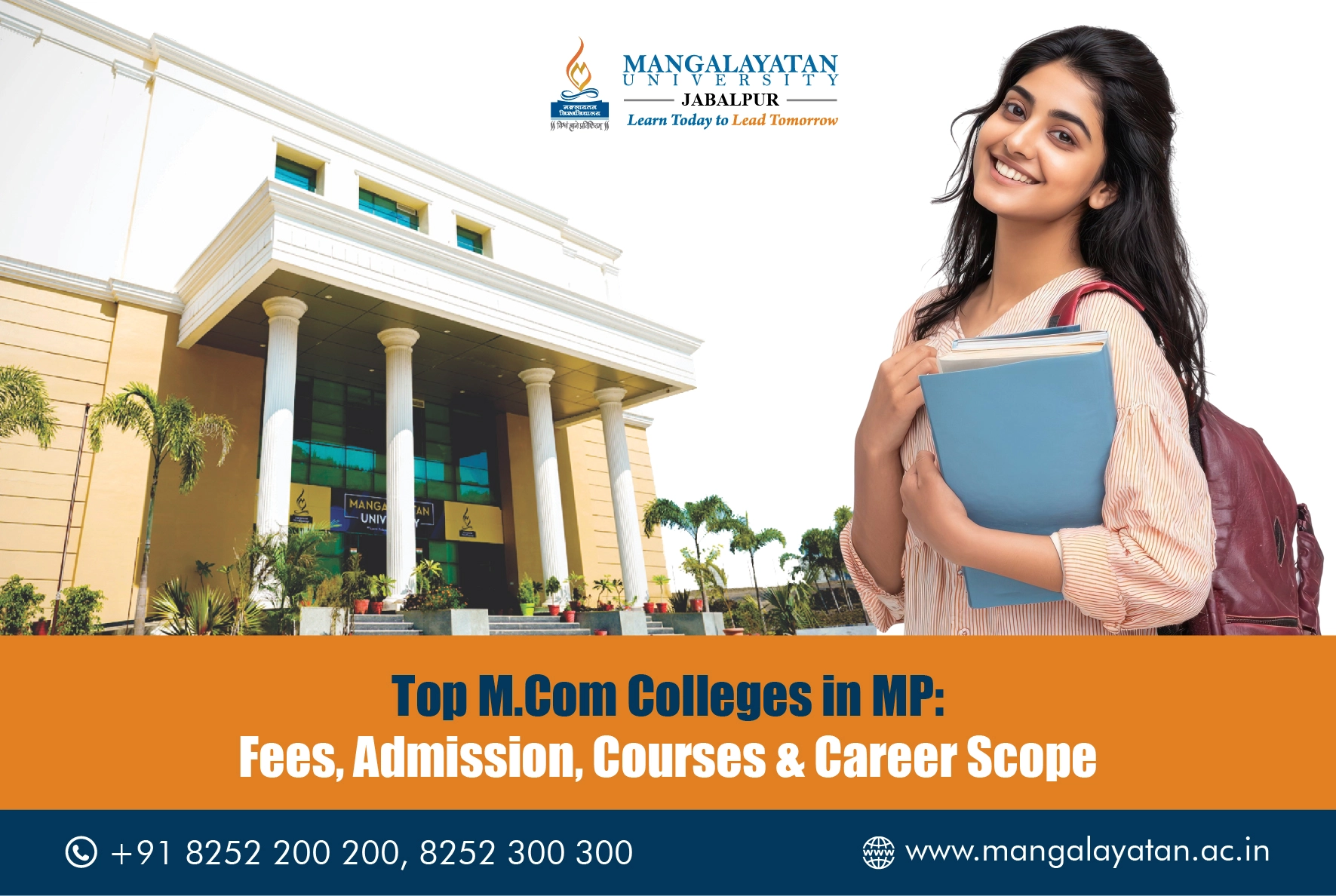
Top M.Com Colleges in MP 2026: Fees, Admission, Courses & Career Scope
Choosing the right postgraduate course after B.Com can make a significant difference to your academic and professional direction. For students who want to deepen their knowledge of accounting, finance, taxation, economics, banking, and business management, a Master of Commerce (M.Com) is a popular postgraduate option. If you are searching for top M.Com colleges in MP, Madhya Pradesh offers several opportunities through government universities, affiliated colleges, private universities, and other higher education institutions.
M.Com is generally a two-year postgraduate program that builds on the concepts studied at the undergraduate level. It can be particularly useful for students who want to develop advanced knowledge in commerce while preparing for careers in finance, accounting, banking, taxation, teaching, research, business, and corporate functions.
In 2026, students looking for M.Com colleges in MP should compare more than course names and fees. Program structure, eligibility, curriculum, faculty, practical learning, research opportunities, location, academic resources, career support, and future study options can all influence the value of a postgraduate degree.
For students considering a private university in Jabalpur, Mangalayatan University offers an M.Com program through its Department of Commerce. The university currently lists the program as a two-year postgraduate course and highlights accounting, economics, taxation, business law, banking, and financial management among its core areas of study.
In this article, we will discuss top M.Com colleges in MP, M.Com colleges in Madhya Pradesh, M.Com courses, eligibility requirements, admission procedures, fees, career opportunities, and factors students should consider before choosing a postgraduate commerce program. We will also look at M.Com Admission 2026, M.Com Eligibility in MP, M.Com Fees in MP, popular M.Com Courses in MP, and the career opportunities available after completing a master’s degree in commerce.
The article also focuses on Mangalayatan University, Jabalpur, and explains its M.Com program, eligibility, fee structure, academic approach, and career relevance. If you have completed B.Com and are wondering whether M.Com is the right next step, this guide can help you understand the course and make a more informed shortlist of colleges.
Why Pursue M.Com in Madhya Pradesh After Graduation?
Madhya Pradesh has a broad higher-education network, making it possible for commerce graduates to pursue postgraduate education in several cities. Students can explore institutions in Jabalpur, Indore, Bhopal, Gwalior, Ujjain, Sagar, and other parts of the state.
The availability of different types of institutions is useful because students have different priorities. Some may prefer a government university or affiliated college because of its fee structure, while others may look for a private university with campus facilities, flexible academic support, and industry-oriented learning.
M.Com can also provide an opportunity to move beyond the fundamentals of B.Com. At the postgraduate level, students can study commerce and finance concepts in greater depth and develop analytical, research, and decision-making abilities.
For students planning careers in accounting, banking, financial services, taxation, business analysis, or teaching, postgraduate commerce education can provide additional academic preparation. Those interested in research or academics can also consider further study after M.Com.
Mangalayatan University’s Department of Commerce describes its M.Com program as focusing on higher levels of knowledge, analytical skills, and managerial capabilities in commerce, finance, and business management.
M.Com Colleges in MP: What Should Students Compare?
When you search for M.Com colleges in MP, you may come across a large number of universities and colleges. However, every institution may offer a different academic environment, curriculum, fee structure, and admission process.
Start by checking whether the college offers the type of M.Com program you want. Some institutions may offer a general M.Com, while others may provide subject combinations or specialization-oriented study.
The curriculum is another important factor. Look for subjects related to accounting, financial management, taxation, economics, business law, banking, auditing, research methodology, and other areas that align with your career interests.
You should also consider the academic resources available to students. A good postgraduate learning environment can include a well-stocked library, digital resources, computer facilities, experienced faculty, seminars, workshops, and opportunities for research or project work.
Fees should be compared carefully as well. Instead of looking only at tuition, check whether registration, examination, library, hostel, or other charges are included.
Finally, consider location. If you are searching for “M.Com colleges near me,” think about commuting costs, accommodation, internships, and your preferred working environment before making a decision.
Best M.Com Colleges in MP: Understanding Your Options
The phrase “Best M.Com Colleges in MP” is commonly used by students while beginning their research. However, there is no single factor that makes one institution the best choice for every student.
A university with a strong academic environment may appeal to a student planning research, while another student may prioritize affordability, location, or industry exposure. Similarly, a student interested in teaching may have different requirements from someone planning a career in banking or corporate finance.
Madhya Pradesh has established universities that offer postgraduate commerce education. Jiwaji University, Gwalior, for example, has regulations covering M.A., M.Sc., M.Com, and other postgraduate programs, with its postgraduate courses structured across four semesters.
Samrat Vikramaditya Vishwavidyalaya, Ujjain, also has M.Com-related academic and examination activity in its current 2026 notifications, demonstrating that postgraduate commerce education remains part of the state’s university ecosystem.
Students should therefore create their own shortlist instead of depending entirely on a generic online ranking. Compare the same criteria for every institution, and then identify the program that fits your academic and professional goals.
M.Com Courses in MP and Subjects You Can Expect
M.Com courses in MP generally build upon the concepts students encounter during B.Com. The exact syllabus differs by university, but postgraduate commerce education commonly involves advanced study of accounting, finance, economics, taxation, auditing, business management, and related areas.
Depending on the university, students may study advanced financial accounting, corporate accounting, cost accounting, financial management, business economics, taxation, auditing, business law, banking, and research methodology.
Mangalayatan University’s M.Com program specifically highlights accounting, economics, taxation, business law, banking, and financial management as important areas within the program. It also describes the course as developing analytical skills and managerial capabilities related to commerce, finance, and business management.
Modern commerce education is also increasingly connected with data and technology. Businesses today use digital accounting systems, financial software, data analysis, and technology-enabled financial services. Therefore, students can benefit from developing digital skills alongside theoretical knowledge.
Before taking admission, download the latest syllabus of the institution you are considering. Comparing the semester-wise subjects can help you understand whether the program matches your career interests.
M.Com Eligibility in MP: Who Can Apply?
M.Com eligibility in MP depends on the university and program. In general, students need a recognized bachelor’s degree, with many institutions giving preference or requiring a commerce background.
The exact percentage and subject requirements can vary. Therefore, students should not assume that eligibility at one university will automatically apply to another.
Mangalayatan University’s official M.Com course page currently specifies graduation in the commerce stream with mathematics and economics as the eligibility requirement. Its 2026 program listing also identifies M.Com as a two-year full-time course.
At the same time, current national CUET-PG mapping material for Mangalayatan University lists an M.Com program and identifies eligibility through a recognized bachelor’s degree/B.Com route. Because admission requirements can be updated, students should verify the latest university admission notification before applying.
This is particularly important for students who have completed a B.Com with different subject combinations or students coming from related undergraduate programs.
M.Com Admission 2026: How Does the Process Work?
M.Com Admission 2026 can vary depending on the institution. Government universities and affiliated colleges may follow university or state-level admission procedures, while private universities may have their own application and selection processes.
The first step is to identify the colleges that match your eligibility. Once you have shortlisted them, check their official admission notifications for application dates, required documents, fees, and selection criteria.
Students may be required to complete an online application form, upload academic documents, submit photographs and identification documents, pay the applicable application fee, and complete document verification.
Some universities may admit students based on merit, while others can use entrance examinations or other selection procedures. For example, universities in Madhya Pradesh publish specific admission notices and schedules through their official systems, so students should check the current notification rather than relying on old dates.
If you are planning M.Com Admission 2026, keep your B.Com marksheets, degree or provisional certificate, identity documents, photographs, and other required documents ready.

M.Com Fees in MP: What Should You Budget?
M.Com fees in MP vary according to the type of institution, program structure, location, and other factors. Government universities and affiliated colleges can have different fee structures from private universities.
Students should not compare colleges only on the basis of annual tuition. Ask whether the quoted amount includes examination, registration, library, development, or other institutional charges.
Mangalayatan University’s current 2026 fee schedule lists M.Com as a two-year program with a fee of ₹30,000 per year. The same schedule lists eligibility as graduation in the commerce stream with mathematics and economics.
This means the listed annual tuition for the two-year M.Com program comes to ₹60,000 across two academic years, before considering any applicable additional charges. Students should verify the latest fee schedule at the time of admission because university fees and applicable charges can change.
When comparing M.Com fees in MP, also consider accommodation, transportation, books, examination expenses, and other living costs. The lowest tuition fee is not always the same as the lowest total cost of studying.
Government and Private M.Com Colleges in Madhya Pradesh
M.Com students in Madhya Pradesh can explore both government/public universities and private institutions.
Public university options can include established universities such as Jiwaji University, Gwalior, Samrat Vikramaditya Vishwavidyalaya, Ujjain, Rani Durgavati Vishwavidyalaya, Jabalpur, and other universities and affiliated colleges, depending on the current program availability and admission cycle.
Jiwaji University’s postgraduate ordinance specifically includes M.Com among its two-year postgraduate degree courses and states that the program is organized across four semesters.
Rani Durgavati Vishwavidyalaya is another major public university in Jabalpur. Its official website provides current 2026 admission notices and information relating to its academic programs.
Private universities provide another route for students who want postgraduate commerce education. Mangalayatan University, Jabalpur, offers M.Com through its Department of Commerce and lists the program as a two-year course.
The important point is that students should verify program availability for the 2026-27 session before considering any college as an active M.Com option.
Why Choose Mangalayatan University, Jabalpur, for M.Com?
Mangalayatan University, Jabalpur, can be considered by students looking for a private university option for postgraduate commerce education. Its Department of Commerce offers B.Com and M.Com programs and describes the department as focused on building academic, analytical, financial, and business capabilities.
The M.Com program has a two-year duration and is designed around areas including accounting, economics, taxation, business law, banking, and financial management. The university also describes the learning approach as including case studies, research-based projects, and industry projects, helping students connect academic concepts with business situations.
The university’s 2026 fee schedule lists M.Com at ₹30,000 per year, making the program’s published tuition structure straightforward for students comparing private M.Com options in MP.
The Department of Commerce page also highlights digital classrooms, Wi-Fi campus facilities, libraries and computer laboratories, industry-oriented curriculum, faculty from academia and industry, educational or industrial tours, and a placement cell.
For students from Jabalpur and nearby areas, the university’s location can also be a practical consideration when comparing M.Com colleges in Madhya Pradesh.
M.Com Learning at MUJ: From Theory to Practical Understanding
Postgraduate commerce education should not stop at memorising concepts. Students need to understand how accounting, taxation, finance, and business decisions work in real organizations.
Mangalayatan University’s M.Com program describes case studies, research-based projects, and industry projects as components of its learning approach. These activities can help students work with real-world business situations, analyze information, and develop problem-solving abilities.
Research-oriented assignments can also help students understand how to collect information, interpret data, develop arguments, and present findings. These skills are relevant not only to academic careers but also to corporate roles where professionals regularly analyze financial and business information.
The university’s Department of Commerce also highlights an industry-oriented curriculum and educational or industrial tours among its academic environment and student-learning features.
For an M.Com student, this combination of subject knowledge and practical exposure can be useful when moving from postgraduate study into employment or further education.
M.Com Career Scope: What Can You Do After Graduation?
M.Com Career Scope extends across accounting, finance, banking, taxation, auditing, education, research, business operations, and corporate functions.
After completing M.Com, graduates can explore roles related to accounting and financial operations. Depending on their skills and employer requirements, they may work in accounting departments, finance teams, banks, insurance companies, tax-related services, consulting organizations, and other business functions.
Students interested in teaching can explore academic pathways subject to the eligibility requirements applicable to teaching or higher-education positions. Those interested in research can consider doctoral-level education after meeting the relevant admission requirements.
M.Com can also support students who want to prepare for professional qualifications. Depending on their interests, they may consider CA, CMA, CS, financial certifications, banking examinations, government examinations, or management education.
However, an M.Com degree does not automatically lead to a particular job. Career outcomes depend on individual skills, experience, recruitment conditions, professional qualifications, and the type of role pursued.
Career Options After M.Com in Accounting and Finance
Accounting remains one of the core career areas for commerce graduates. M.Com can provide deeper academic understanding of financial accounting, corporate accounting, taxation, auditing, and financial management.
Graduates can explore entry-level and mid-level opportunities depending on their previous experience and skills. Job profiles may include accountant, accounts executive, finance executive, audit assistant, taxation executive, financial operations executive, and related positions.
Finance is another major area. Students can build careers in financial operations, banking, investment-related support functions, credit operations, insurance, and business finance.
Technology is also influencing finance careers. Digital payments, financial technology, automated accounting, data-driven decision-making, and online banking have increased the importance of digital capabilities.
For this reason, M.Com students can strengthen their career profile by learning Excel, accounting software, financial analysis tools, data interpretation, and professional communication.
M.Com and Banking: Is It a Useful Qualification?
Students interested in banking often consider M.Com because the program covers several concepts relevant to financial institutions, including accounting, economics, finance, and banking.
M.Com can provide an academic foundation for understanding financial statements, banking systems, economic concepts, and business transactions. However, students preparing for competitive banking examinations need to prepare separately according to the syllabus and selection process of the examination they target.
For private banking and financial services roles, practical skills can be equally important. Communication, customer handling, financial product knowledge, data analysis, Excel, and understanding of banking operations can help students prepare for workplace requirements.
Students should therefore treat M.Com as one part of their career preparation rather than expecting the degree alone to determine their professional outcome.
M.Com for Teaching, Research, and Higher Studies
Some students choose M.Com because they are interested in academics, teaching, or research. A postgraduate degree can provide a deeper understanding of commerce and create a pathway toward further academic qualifications.
Students interested in research can explore PhD programs after completing an M.Com, subject to the eligibility and entrance requirements of the university they choose.
Mangalayatan University’s Department of Commerce currently lists PhD in Commerce alongside its B.Com and M.Com programs, creating an academic progression from undergraduate to postgraduate and research-level study within the department.
Students planning an academic career should also research eligibility requirements for NET and other relevant examinations, as well as university-specific requirements for doctoral admissions.
Skills to Build Alongside Your M.Com Degree
Your postgraduate degree becomes more valuable when you develop practical skills alongside classroom learning.
Advanced Excel is useful for accounting, financial reporting, data analysis, and business operations. Students can also learn accounting software and develop familiarity with digital financial systems.
Communication skills matter because finance and commerce professionals regularly prepare reports, explain financial information, and communicate with managers, clients, and colleagues.
Analytical thinking is another important skill. An M.Com student should be able to interpret financial information, identify patterns, understand business problems, and present logical conclusions.
Research and presentation skills can also help students in both academic and professional settings. Projects, seminars, and case studies can provide opportunities to practice these abilities.
Students should also consider internships, industry visits, and project work wherever available. Practical experience can make it easier to understand how academic concepts translate into workplace responsibilities.

M.Com Placement and Career Support: What Should You Check?
Students searching for M.Com colleges in MP 2026 often want to know about placements. Instead of focusing only on a single placement percentage or salary figure, look at the complete career-support ecosystem.
Check whether the university has a placement cell, whether students receive interview preparation, whether companies or organizations interact with students, and whether internships or industry projects are available.
Mangalayatan University’s Department of Commerce identifies a dynamic placement cell among the features of its academic environment and also mentions industry interaction and industry-oriented curriculum.
The university’s M.Com course page also identifies sectors and organizations such as banking, accounting, investments, and marketing as relevant career areas and names companies including KPMG, PwC, HDFC Bank, SBI, and ICRA in its discussion of potential recruiters. These should be understood as examples cited by the university, not as a guarantee that every M.Com student will be recruited by these organizations.
When evaluating placement information, always distinguish between placement assistance, internship opportunities, recruiters listed by an institution, and guaranteed employment. These are not the same thing.
M.Com vs. MBA: Which Postgraduate Course Should You Consider?
After B.Com, students sometimes find themselves choosing between M.Com and MBA.
M.Com generally provides deeper academic study of commerce, accounting, taxation, economics, and finance. MBA, on the other hand, generally focuses more broadly on management areas such as marketing, human resources, finance, operations, strategy, and business administration.
If you enjoy commerce, accounting, finance, and analytical subjects, M.Com may align more closely with your academic interests. If you want a broader management-oriented education and are interested in leadership, business strategy, or organizational functions, an MBA program may be another option to research.
Your choice should depend on your intended career, interests, existing skills, and the program structure offered by the institutions you are considering.
M.Com Colleges in Madhya Pradesh: Why Location Can Matter
Location can influence the overall cost and experience of postgraduate education. Students from Jabalpur and nearby districts may prefer to study locally, while others may consider Bhopal, Indore, Gwalior, or Ujjain based on academic and career preferences.
When comparing M.Com colleges in Madhya Pradesh, calculate the total cost of studying at each location. A college with slightly higher tuition but lower accommodation and transportation expenses may have a different overall cost from an institution where you need to relocate.
Location can also influence access to internships, businesses, professional networks, and part-time opportunities. However, students should not choose a city only for its reputation. The specific course and academic environment remain important.
Mangalayatan University is located on NH-30, Mandla Road, near Sharda Devi Mandir, Richai, Barela, Jabalpur, Madhya Pradesh.
Documents and Preparation for M.Com Admission 2026
Before applying for M.Com Admission 2026, students should prepare their undergraduate academic records and other documents required by the institution.
Typically, students may need their Class 10 and Class 12 marksheets, graduation marksheets, degree or provisional certificate, identity proof, photographs, and other documents specified in the admission notification.
If your final graduation result is pending, check whether the institution permits provisional application or admission subject to submission of final documents.
Students should also carefully verify their subject eligibility. This is especially important for M.Com because universities can have different requirements regarding the undergraduate stream and subjects.
For Mangalayatan University, the current M.Com course page specifies graduation in the commerce stream with mathematics and economics. The university’s broader admissions material currently lists M.Com eligibility as graduation in commerce. Because admission requirements can be updated, applicants should confirm the exact 2026-27 criteria directly with the university before submitting an application.
How to Select the Right M.Com College in MP?
Once you have shortlisted M.Com colleges in MP, compare them using the same set of questions.
First, ask whether the program matches your academic background. Next, compare duration, curriculum, specializations, and fees. Then look at faculty, the library, digital resources, research opportunities, internships, and industry exposure.
You should also examine the admission process and whether the university uses merit, entrance examination, or another selection method.
Career support is another consideration. Look for placement assistance, internship opportunities, professional interaction, alumni engagement, and skill-development programs.
Finally, consider location and total expenses. A practical decision should account for tuition, accommodation, travel, study materials, and other costs.
Most importantly, verify information from the official university source. Fees, eligibility, admission dates, and program structures can change between academic sessions.
Future Scope of M.Com in a Digital Business Environment
Commerce is changing as businesses adopt digital financial systems, online transactions, automated accounting, data analytics, and technology-driven financial services.
This does not mean traditional commerce knowledge has become less important. Instead, the role of commerce professionals increasingly combines financial understanding with technology and analytical capabilities.
M.Com students can therefore benefit from developing a hybrid skill set. Understanding accounting and finance provides the academic foundation, while digital tools and analytical skills can help students work with modern business systems.
Students can also explore areas such as financial analytics, taxation technology, digital banking, compliance, business research, and corporate finance as their interests develop.
The long-term value of an M.Com degree can therefore depend not only on the qualification itself but also on how effectively students combine postgraduate knowledge with practical and digital skills.
Why Can Mangalayatan University Be Considered for M.Com in Jabalpur?
For students specifically looking for an M.Com program in Jabalpur, Mangalayatan University provides a private university option with a dedicated Department of Commerce.
The university lists M.Com as a two-year postgraduate program and describes the course as covering accounting, economics, taxation, business law, banking, and financial management. Its program information also highlights case studies, research-based projects, and industry projects.
The 2026 fee schedule lists M.Com at ₹30,000 per year, while the department page highlights facilities such as digital classrooms, Wi-Fi campus, library resources, computer laboratories, industry-oriented curriculum, and placement support.
For a student comparing private M.Com colleges in Madhya Pradesh, these factors can be considered alongside eligibility, curriculum, location, practical exposure, and career plans.
The university also lists B.Com, M.Com, and PhD in Commerce within its Department of Commerce, providing students interested in commerce with a broader academic pathway.
Conclusion: Planning Your M.Com Journey in MP
Choosing among the top M.Com colleges in MP requires careful comparison rather than relying only on college names or online rankings. You should examine M.Com eligibility in MP, course duration, M.Com fees in MP, curriculum, faculty, practical learning, research opportunities, placement support, and location before applying.
Madhya Pradesh offers students a variety of public and private options for postgraduate commerce education. Universities such as Jiwaji University, Samrat Vikramaditya Vishwavidyalaya, and Rani Durgavati Vishwavidyalaya are part of the state’s wider higher-education landscape, while private universities such as Mangalayatan University provide additional choices.
If you are looking for a private university in Jabalpur, Mangalayatan University’s two-year M.Com program, published fee structure, commerce-focused curriculum, and practical-learning approach can be included in your shortlist.
Ultimately, the right postgraduate program is one that matches your academic background, budget, interests, and career direction. Use 2026 admission information as your starting point, verify the latest eligibility and fee details, and choose your M.Com program after comparing the complete academic and professional picture.
Frequently Asked Questions About M.Com Colleges in MP
Which are the top M.Com colleges in MP in 2026?
There is no single official ranking that determines the top M.Com college for every student. Students can research established public universities, affiliated colleges, and private universities offering M.Com and compare them according to curriculum, fees, eligibility, facilities, and career support.
What is the duration of the M.Com in Madhya Pradesh?
M.Com is commonly a two-year postgraduate program. Mangalayatan University currently lists its M.Com program as a two-year course.
What is M.Com eligibility in MP?
Eligibility varies by university. Mangalayatan University’s current M.Com course page specifies graduation in the commerce stream with mathematics and economics. Students should check the latest admission notification because eligibility requirements can be updated.
What are the M.Com fees in MP?
Fees vary by institution. Mangalayatan University’s 2026 fee schedule lists M.Com at ₹30,000 per year. Additional applicable charges should be checked in the current fee structure.
What subjects are taught in M.Com?
Depending on the university, M.Com may cover advanced accounting, economics, taxation, financial management, banking, auditing, business law, research methodology, and related commerce subjects. Mangalayatan University’s program specifically highlights accounting, economics, taxation, business law, banking, and financial management.
Can I pursue M.Com after B.Com?
Yes, M.Com is a postgraduate commerce program commonly pursued after a B.Com or another eligible bachelor’s degree, subject to the admission requirements of the university.
What is the M.Com career scope?
M.Com Career Scope includes opportunities in accounting, finance, banking, taxation, auditing, financial services, business operations, education, and research. Students can also pursue professional qualifications or further higher education.
Is M.Com useful for banking careers?
M.Com can provide academic knowledge relevant to banking and finance, including accounting, economics, and financial management. Students targeting competitive banking examinations should also prepare according to the specific examination syllabus.
Can M.Com graduates pursue PhDs?
Yes, M.Com graduates can explore PhD programs subject to university-specific eligibility and admission requirements. Mangalayatan University’s Department of Commerce currently lists PhD in Commerce alongside B.Com and M.Com.
What should I check before M.Com Admission 2026?
Check eligibility, course duration, syllabus, fees, admission mode, application deadlines, faculty, practical learning, research opportunities, placement support, and location. Always verify the latest information through the official university admission notification.
Why choose Mangalayatan University for M.Com?
Mangalayatan University, Jabalpur, offers a two-year M.Com program covering areas such as accounting, economics, taxation, business law, banking, and financial management. Its department highlights case studies, research-based projects, industry projects, digital classrooms, library resources, and placement support.