
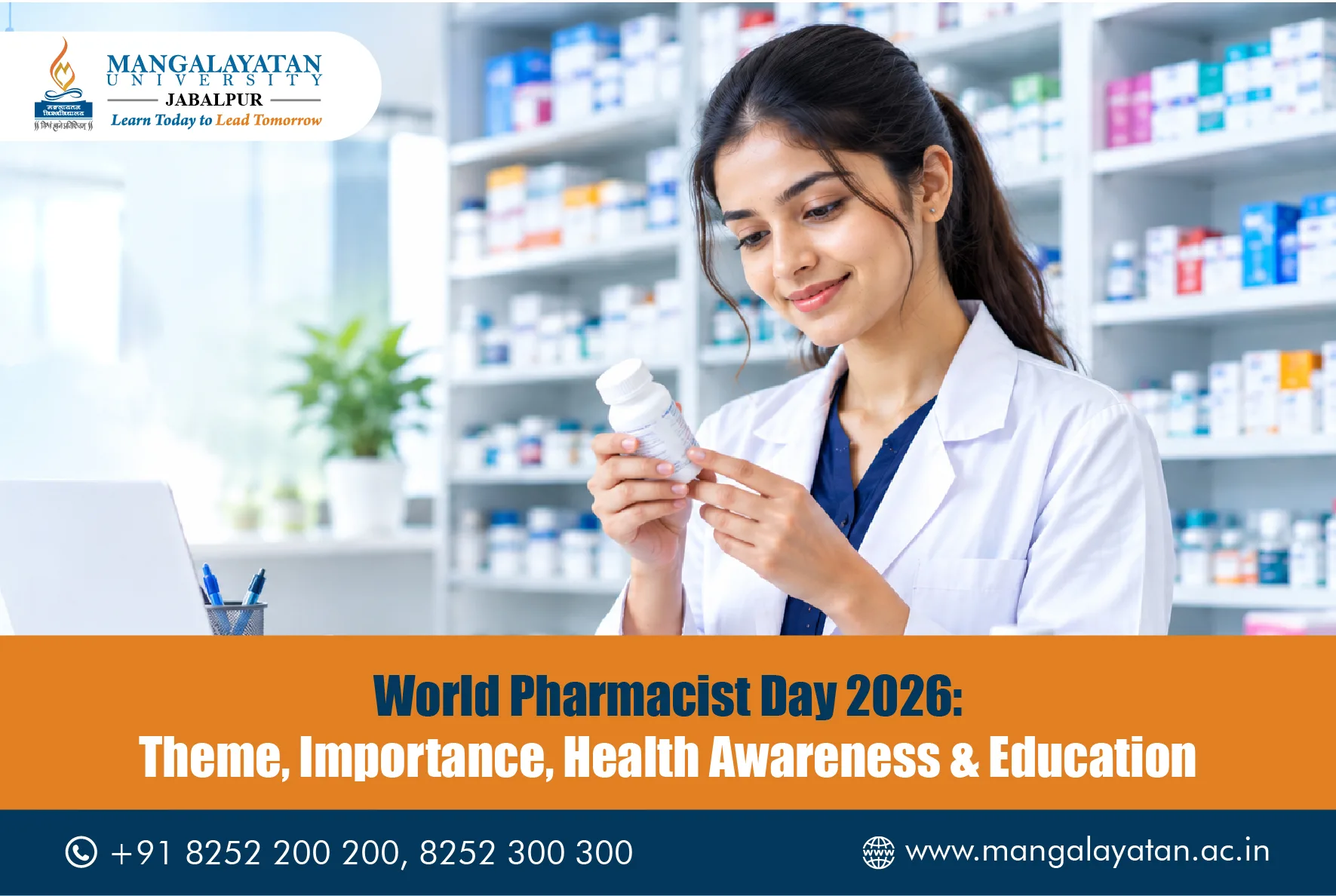
World Pharmacist Day 2026: Theme, Importance, Health Awareness & Education
Every year on 25 September, World Pharmacist Day reminds us that healthcare is not only about doctors and hospitals. Pharmacists also play an important role in helping people use medicines safely, understand treatments, and make informed health decisions. For students who are interested in healthcare but want to explore a career beyond traditional medical courses, pharmacy can open the door to several professional opportunities.
World Pharmacist Day 2026 is especially significant because the International Pharmaceutical Federation (FIP) has announced the theme “Empowering pharmacists for healthier futures.” The theme focuses on giving pharmacists the education, skills, recognition, and support they need to contribute effectively to changing healthcare needs.
For students searching for B.Pharm courses after 12th, pharmacy colleges in Jabalpur, B.Pharm admission 2026, pharmacy courses in Madhya Pradesh, or a career in the pharmaceutical industry, this day is also an opportunity to understand what pharmacy really means and why skilled pharmacy professionals matter.
What is World Pharmacist Day 2026?
World Pharmacist Day 2026 is observed on 25 September under the global theme “Empowering pharmacists for healthier futures.” The campaign is led by the International Pharmaceutical Federation (FIP), which adopted World Pharmacists Day in 2009. The date also marks the anniversary of FIP’s establishment in 1912.
The day celebrates the contribution of pharmacists across different areas of healthcare, including community pharmacy, hospitals, pharmaceutical manufacturing, research, drug safety, education, regulatory affairs, and public health.
For us, the message is simple: medicines can only create their intended benefits when they are developed, tested, manufactured, prescribed, dispensed, and used responsibly. Pharmacists contribute at several points in this process.
World Pharmacist Day 2026 Theme: “Empowering Pharmacists for Healthier Futures”
The World Pharmacist Day 2026 theme reflects how quickly healthcare is changing. Population aging, chronic diseases, technological developments, digital healthcare, and other emerging challenges are creating new demands on health systems. FIP says pharmacists are positioned at the intersection of medicines, scientific innovation, and patient care.
This makes pharmacy education more important than ever.
A modern pharmacist needs more than knowledge about medicines. Students must develop scientific understanding, analytical ability, communication skills, ethical awareness, and practical knowledge. They also need to understand how pharmaceutical research, technology, regulation, and patient safety work together.
This is why choosing the right pharmacy course after 12th can be an important first step for students who want to build a healthcare career.
Why is World Pharmacist Day Important?
The importance of World Pharmacist Day goes beyond celebrating a profession. It creates awareness about how pharmacists contribute to everyday healthcare.
According to WHO, pharmacists can contribute to access to medicines, patient guidance, disease prevention, health education, vaccination and health screening, pharmaceutical research, and pharmacovigilance.
Think about a person who has just received a prescription. They may have questions about dosage, timing, storage, possible interactions, or how to take medicines correctly. A trained pharmacist can play an important role in supporting safe medicine use.
The WHO’s Medication Without Harm initiative also highlights the shared responsibility of patients and healthcare professionals, including pharmacists, in improving medication safety. Its public message encourages people to “KNOW. CHECK. ASK” when using medicines.
This is why pharmacy education is not simply about learning the names of medicines. It is about understanding the science and responsibility behind them.
Role of Pharmacists in Health Awareness
Health awareness is becoming increasingly important in a world where people receive enormous amounts of health information through social media, websites, and online platforms.
Not every piece of health information available online is accurate. This is where trained healthcare professionals can make a difference.
Pharmacists can help people understand medicines, encourage responsible medicine use, and support health awareness initiatives. They can also contribute to conversations around medication adherence, prevention, and safe healthcare practices.
WHO’s 2026 health campaign, “Together for health. “Stand with science” similarly emphasizes the importance of evidence, facts, and science-based guidance in protecting health.
As future pharmacy professionals, students can become part of this science-based approach to healthcare.
Pharmacy Education: Why Does It Matter?
A strong pharmacy education creates the foundation for responsible professional practice. Students studying pharmacy learn about subjects that connect chemistry, biology, medicine, and healthcare.
A B.Pharm course can introduce students to areas such as pharmaceutical chemistry, pharmaceutics, pharmacology, pharmacognosy, pharmaceutical analysis, and other pharmaceutical sciences.
But classroom learning is only one part of the journey.
Students also need laboratory exposure, practical learning, research understanding, communication skills, and awareness of pharmaceutical regulations. These experiences can help them understand how medicines are formulated, analyzed, evaluated, and handled.
At Mangalayatan University, Jabalpur, the Department of Pharmaceutical Sciences offers B.Pharm and D.Pharm programs with an emphasis on pharmaceutical science, practical learning, research, industrial exposure, and professional ethics.
B.Pharm Course After 12th: Is Pharmacy a Good Career Option?
If you have completed Class 12 with science and are searching for professional courses after 12th, pharmacy is one of the healthcare-oriented options you can consider.
The Bachelor of Pharmacy (B.Pharm) is a four-year undergraduate program. The dedicated B.Pharm program information of Mangalayatan University, Jabalpur, lists eligibility through 10+2 with PCM/PCB and describes the program as combining theoretical foundations with practical exposure and industrial orientation.
The course can be relevant for students interested in:
- Medicines and pharmaceutical sciences
- Healthcare and patient safety
- Drug formulation and development
- Laboratory work
- Pharmaceutical research
- Quality control
- Clinical research
- Pharmaceutical manufacturing
- Regulatory affairs
- Healthcare entrepreneurship
However, pharmacy should not be chosen only because someone says it is a “high-salary course.” You should choose it if you are genuinely interested in science, healthcare, medicines, laboratory learning, and responsible professional work.
What Do Students Learn in a B.Pharm Course?
One of the biggest advantages of studying pharmacy is the combination of theoretical and practical learning.
During a B.Pharm course, students can study areas connected with drug formulation, pharmaceutical chemistry, pharmacology, pharmaceutical analysis, pharmacognosy, and other branches of pharmaceutical science.
At MUJ, the B.Pharm program is designed around pharmaceutical sciences, drug development, formulation, quality control, pharmacology, clinical research, and patient safety. The university also highlights laboratory learning, research exposure, internships, and skill development.
This type of multidisciplinary learning can help students understand the journey of a medicine—from scientific development and formulation to quality evaluation and its responsible use.
Career Opportunities After B.Pharm
A pharmacy degree can lead to careers across different areas of healthcare and the pharmaceutical sector.
Depending on your qualifications, skills, experience, and applicable regulatory requirements, you can explore opportunities such as
- Pharmaceutical Industry: Students can work in production, formulation, quality assurance, and quality control.
- Clinical Research: Pharmacy graduates can explore clinical research and related roles involving research processes, documentation, and data.
- Regulatory Affairs: Professionals in this field work with pharmaceutical regulations, documentation, and compliance requirements.
- Pharmacovigilance: This area focuses on monitoring and evaluating medicine safety.
- Hospital and Community Pharmacy: Pharmacists can work in healthcare settings where medicines and patient support are central to their responsibilities.
- Medical and Pharmaceutical Marketing: Students with strong communication and product knowledge can explore pharmaceutical sales and marketing roles.
- Research and Higher Education: Students interested in academics and research can consider postgraduate study and research pathways.
- Entrepreneurship: Depending on applicable registration and regulatory requirements, pharmacy professionals can also explore opportunities in pharmacy businesses and pharmaceutical enterprises.
This diversity is one reason why students searching for a B.Pharm career scope, pharmacy jobs after graduation, and career options after B.Pharm continue to explore this field.
Why Choose a Pharmacy Course at Mangalayatan University, Jabalpur?
Choosing a university is an important decision because your learning environment can influence your academic and professional development.
At Mangalayatan University, Jabalpur, the Department of Pharmacy offers B.Pharm and D.Pharm programs. The university highlights practical learning, experienced faculty, laboratory facilities, industry-oriented education, internships, research exposure, and career support.
For students searching for B.Pharm colleges in Jabalpur or pharmacy colleges in Jabalpur, MUJ provides an environment where theoretical education is combined with practical and industry-oriented learning.
The university’s pharmacy program information also highlights laboratories for areas such as pharmaceutics, pharmacology, pharmaceutical chemistry, and microbiology, along with industrial visits, live projects, and skill development.
The Pharmacy Council of India has also published documentation listing Mangalayatan University Jabalpur with D.Pharm and B.Pharm programs and recording approval information for the 2025–26 academic session. Students should always check the latest regulatory approval and admission information for the session in which they intend to enroll.

B.Pharm vs. D.Pharm: Which Course Should You Consider?
Students often search for B.Pharm vs. D.Pharm when deciding on their pharmacy career pathway.
B.Pharm is a four-year undergraduate degree that provides broader academic exposure to pharmaceutical sciences and can support multiple higher-study and career pathways.
D.Pharm is a two-year diploma program designed to provide foundational professional education in pharmacy. MUJ currently lists both B.Pharm and D.Pharm among its pharmacy programs.
Your decision should depend on your academic background, career goals, interest in higher education, and the professional pathway you want to pursue.
How Can Students Celebrate World Pharmacist Day 2026?
You do not need to be a pharmacy student to participate in World Pharmacist Day 2026.
You can start by learning more about the safe use of medicines and avoiding self-medication based on unverified online advice. Students can participate in health-awareness activities, pharmacy seminars, poster competitions, educational campaigns, and discussions about medicine safety.
If you are already studying pharmacy, this day can be a reminder of the responsibility associated with your future profession.
And if you are a Class 12 student exploring career options, World Pharmacist Day can be the starting point for learning more about B.Pharm admission 2026, pharmacy courses after 12th, B.Pharm eligibility, pharmacy career scope, and pharmacy colleges in Madhya Pradesh.
Pharmacy and the Future of Healthcare
The future of pharmacy will not be limited to traditional dispensing roles. Pharmaceutical research, biotechnology, digital healthcare, precision medicine, drug safety, clinical research, and data-driven healthcare are creating new areas of professional interest.
At the same time, the fundamentals remain unchanged: medicines must be safe, effective, appropriately used, and supported by scientific evidence.
The 2026 World Pharmacist Day theme captures this changing environment by focusing on empowering pharmacists for healthier futures.
For students, this means that pharmacy education should prepare you not only for today’s pharmaceutical industry but also for the healthcare challenges of tomorrow.
Conclusion: Build Your Future in Pharmacy with the Right Education
World Pharmacist Day 2026 is more than an annual celebration. It is an opportunity to understand the contribution of pharmacists to healthcare, medicine safety, health awareness, research, and patient care.
The theme “Empowering pharmacists for healthier futures” highlights the importance of skilled, educated, and supported pharmacy professionals in modern healthcare.
If you are a science student looking for a professional healthcare course after Class 12, pharmacy can give you an opportunity to combine scientific knowledge with meaningful work. The right education can help you develop practical skills, professional confidence, and a deeper understanding of medicines and healthcare.
At Mangalayatan University, Jabalpur, students can explore B.Pharm and D.Pharm programs designed around pharmaceutical sciences, practical learning, research, industry exposure, and career development.
So, this World Pharmacist Day, if you are asking yourself, “Is B.Pharm a good career option after 12th?” do not look only at job titles or salary figures. Look at the science, responsibility, learning opportunities, and long-term career pathways the profession can offer.
Because a pharmacist does more than work with medicines. A trained pharmacy professional contributes to a healthcare system where knowledge, science, safety, and patient well-being come together.