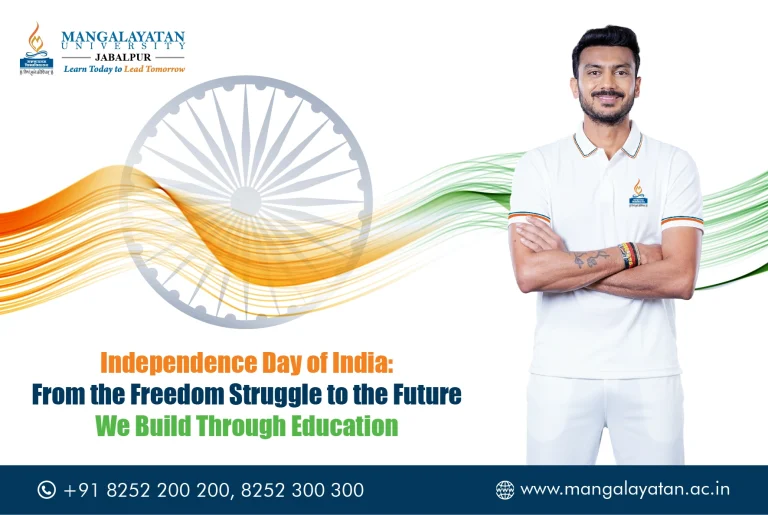
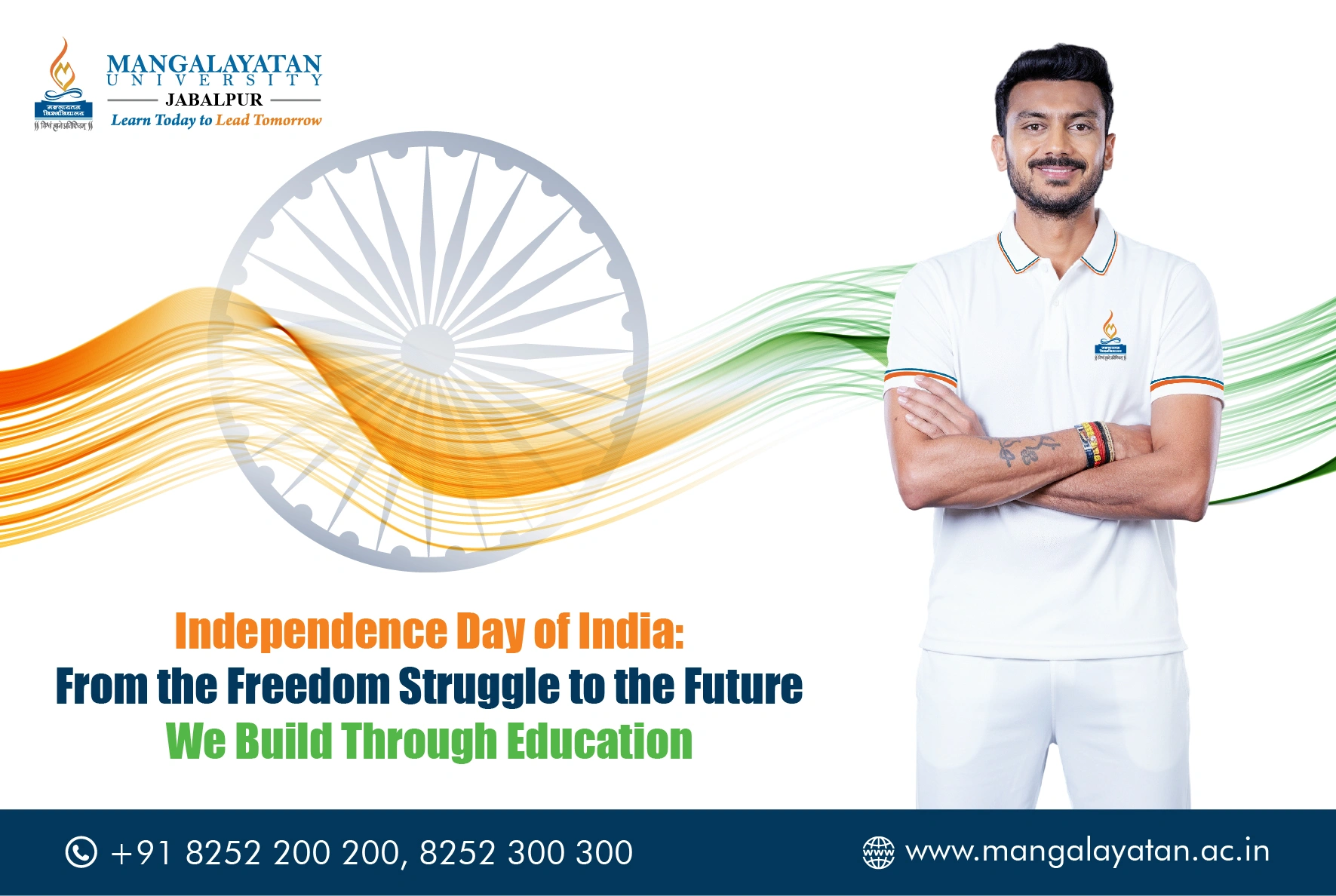
Independence Day of India: From the Freedom Struggle to the Future We Build Through Education
Every year, on 15 August, India pauses for a moment. The tricolor rises. The national anthem fills the air. Schools and universities organize cultural programs. Families watch the Independence Day celebrations from the Red Fort. Students participate in speeches, quizzes, debates, patriotic performances, and flag-hoisting ceremonies.
But Independence Day of India is much more than a national celebration.
It is a reminder of what millions of Indians struggled, sacrificed, and dreamed for—and a question for every generation that came after them:What will you do with the freedom they gave you?
For a student, that question has a very practical answer. You can learn. You can develop skills. You can question, innovate, create, serve society, and build a career that contributes to India’s future.At Mangalayatan University, Jabalpur (MUJ), we believe this is one of the most meaningful ways to understand the spirit of Independence Day. Freedom gave India the opportunity to determine its own destiny. Education gives young Indians the ability to participate in that destiny.
As India observes Independence Day on 15 August 2026, the occasion offers an opportunity to look back at the journey from colonial rule to a modern, ambitious, and increasingly knowledge-driven nation—and to think about the role you can play in India’s next chapter.
Independence Day of India: Why Do We Celebrate 15 August?
India became independent from British colonial rule on 15 August 1947.The transition was not simply an administrative change. It represented the culmination of decades of political movements, social mobilization, resistance, sacrifice, and negotiations.
The significance of 15 August therefore goes beyond a date on the calendar. It represents the moment when India began its journey as an independent nation and assumed responsibility for shaping its own political, economic, and social future. The Government of India also describes 15 August 1947 as the moment when India became independent and began becoming the architect of its own national destiny.
In 2025, India celebrated its 79th Independence Day. Therefore, 15 August 2026 marks India’s 80th Independence Day celebration and 79 years since independence. This distinction matters because people sometimes incorrectly call 2026 the “79th Independence Day.” The anniversary count and the number of years completed are different ways of expressing the same historical milestone.For today’s students, the important question is not simply, “How many years of independence?”It is:How far has India traveled—and where do you want to take it next?
What Happened on 15 August 1947?
The story of Indian independence did not begin in 1947.The resistance to colonial rule developed over generations. The Revolt of 1857, the formation of the Indian National Congress in 1885, the Swadeshi movement, the Non-Cooperation Movement, the Civil Disobedience Movement, and the Quit India Movement of 1942 and countless local struggles formed parts of a much larger freedom movement.
Millions of people participated in different ways.Some became political leaders. Some organized movements. Some wrote newspapers and literature. Some boycotted foreign goods. Some went to prison. Some took revolutionary paths. Others worked quietly in villages and communities.
The freedom movement was therefore not the achievement of one individual or one organization. It was a long and complex national struggle involving people from different regions, communities, professions, and social backgrounds.
The final transition came in 1947.The Indian Independence Act received Royal Assent on 18 July 1947, providing the legal framework for the creation of the independent Dominions of India and Pakistan. On the night of 14–15 August, the transfer of power took place, marking the end of British rule.
At the Constituent Assembly, Jawaharlal Nehru delivered his famous “Tryst with Destiny” speech as India entered independence. The moment was historic because India was not merely receiving freedom. India was beginning the difficult task of building a nation. That distinction remains relevant today.
From Political Freedom to Educational Freedom
Imagine India in 1947.The country had just emerged from colonial rule and faced enormous challenges: poverty, displacement, illiteracy, weak infrastructure, limited industrial capacity, and the difficult task of integrating a diverse population into a functioning democratic nation.
Education became central to that transformation. A free nation needs educated citizens. Democracy requires people who can understand institutions, rights, and responsibilities. Economic development requires engineers, scientists, doctors, entrepreneurs, teachers, lawyers, researchers, agricultural experts, and skilled professionals.
This is why the story of Indian independence cannot end with 1947.The next chapter was about nation-building. And that chapter continues today. The Ministry of Education’s All India Survey on Higher Education (AISHE) shows how significantly India’s higher education system has expanded. According to AISHE 2021-22, India had 1,168 universities or university-level institutions, 45,473 colleges, and 12,002 standalone institutions registered in the survey. Total higher education enrollment had reached nearly 4.33 crore students. A later Ministry of Education annual report notes that total higher education enrollment increased further to nearly 4.46 crore in 2022-23, compared with 3.42 crore in 2014-15.
These numbers tell us something important. India’s freedom journey has gradually expanded from the freedom to govern ourselves to the freedom to learn, innovate, choose careers, and create opportunities.
Why Education Is One of the Strongest Expressions of Freedom
What does freedom mean to a young person? It can mean the ability to choose your profession. It can mean the opportunity to study engineering even if your parents were not engineers. It can mean becoming a lawyer, entrepreneur, pharmacist, software developer, physiotherapist, agricultural scientist, or management professional. It can mean building a startup instead of simply looking for a job. It can mean using technology to solve a problem in your village.It can mean pursuing research that improves healthcare, agriculture, or environmental sustainability. Education expands these possibilities.
At Mangalayatan University, Jabalpur, we see education not merely as the process of earning a degree but as preparation for responsible participation in society.
Our academic offerings span areas such as engineering and technology, management, law, computer applications, agriculture, pharmacy, forensic science, medical and allied health sciences, commerce, humanities, and social sciences. The university’s current admission information lists programs including B.Tech CSE and specialized B.Tech CSE programs in AI & ML, Data Science, and Cyber Security, along with BCA, MCA, BBA, MBA, law, agriculture, pharmacy, forensic science, BPT, and medical laboratory-related programs.
That diversity matters because India does not need only one kind of professional.
It needs many kinds of talent.
Independence Day 2026: Why Students Should Think Beyond Celebration
On Independence Day, it is easy to focus only on patriotic songs, flag hoisting, and social media posts.But perhaps the deeper celebration begins when you ask yourself the following:
What can I contribute to India? If you are studying B.Tech, perhaps your contribution will come through technology. If you choose BCA or MCA, perhaps you will build software, cybersecurity solutions, or digital platforms. If you pursue a BBA or MBA, perhaps you will create businesses and employment. If agriculture interests you, you may work on sustainable farming, horticulture, forestry, or agricultural innovation.If healthcare is your passion, courses such as BPT, BMLT, or allied health programs can help you develop professional skills that contribute to India’s healthcare ecosystem.
If law interests you, legal education can prepare you to understand institutions, rights, justice, and governance.If you enjoy humanities and social sciences, your contribution may come through research, education, public administration, communication, psychology or social development.This is where Independence Day becomes personal.Your career is not separate from the country’s development.Millions of individual career decisions collectively shape a nation’s future.
The Tricolorpsychology, and What It Teaches Us
The Indian national flag was adopted in its present form by the Constituent Assembly on 22 July 1947, only weeks before independence. The National Portal of India explains that the flag has three horizontal bands—saffron, white, and green—with the navy-blue Ashoka Chakra at the center. The colors carry symbolic meaning. Saffron represents strength and courage. White represents peace and truth.
Green represents fertility, growth, and the land.The Ashoka Chakra contains 24 spokes and represents the wheel of law and movement. The National Portal describes its broader message as reflecting the importance of movement and progress rather than stagnation.
There is a powerful lesson here for students.Knowledge must move.Learning must move from the classroom to the laboratory.Ideas must move from research papers to real-world solutions.Skills must move from training to employment.Innovation must move from imagination to implementation.And education must move beyond examinations toward meaningful contribution.
Why India’s Future Depends on Skilled Young People
India is one of the world’s youngest major populations, and its demographic profile creates both an opportunity and a responsibility.A large young population becomes a strength only when young people have access to quality education, relevant skills, and opportunities.This is where higher education becomes strategically important.
According to AISHE, India’s higher education enrollment increased from 3.42 crore in 2014-15 to nearly 4.33 crore in 2021-22. Female enrollment also increased substantially, reaching about 2.07 crore in 2021-22.The expansion shows that more Indians are entering higher education.But quantity alone is not enough.The next challenge is quality, employability, innovation, and relevance.
Employers increasingly expect graduates to combine academic knowledge with communication, analytical thinking, digital literacy, problem-solving, teamwork, and adaptability.That is why choosing the right course after Class 12 matters.
Which Courses Can Help You Build a Career for India’s Future?
If you are searching for the best courses after 12th, professional courses after 12th, UG courses in Jabalpur, or career-oriented degree programs, you should begin by understanding your interests and strengths.At MUJ, students can explore programs across multiple disciplines.
B.Tech CSE and Emerging Technology Programs
Technology is changing almost every industry.Artificial intelligence, machine learning, data science, and cybersecurity are influencing businesses, healthcare, banking, education, manufacturing, and public services.For students interested in coding, computing, and technology, B.Tech Computer Science and Engineering can provide a foundation for careers in software, technology, and related fields.
MUJ also lists B.Tech CSE programs in AI & ML, Data Science, and Cyber Security, allowing students to explore emerging technology domains.The important point is not to choose a technology course simply because it sounds fashionable.Choose it if you are willing to learn continuously.Technology rewards curiosity.
BCA and MCA: Building India’s Digital Workforce
Not every student who wants a technology career necessarily follows the B.Tech route.BCA can provide an undergraduate pathway into computer applications and IT.After graduation, students can consider MCA for advanced study in computer applications.
MUJ lists BCA as a three-year undergraduate program and MCA as a two-year postgraduate program, subject to the stated eligibility requirements.Potential career directions can include software development, web development, database management, IT support, application development, and other technology roles, depending on your skills and specialization.
The degree gives you a foundation.Your projects, internships, technical skills, and continuous learning determine how effectively you use it.
BBA and MBA: Freedom to Create Opportunities
India’s development needs entrepreneurs and business professionals who can understand markets, manage teams, analyze information, and create sustainable organizations.
A BBA course can be a strong starting point for students interested in business administration, marketing, finance, human resources, operations, and entrepreneurship.An MBA can take that learning to a more advanced level.
MUJ currently offers BBA and MBA programs, with BBA listed as a three-year undergraduate course and MBA as a two-year postgraduate program.But management education should not be viewed simply as a route to a corporate job. It can also prepare you to become a creator of opportunities.One entrepreneur can potentially create jobs for many others.That is another form of nation-building.
Agriculture: India’s Freedom Is Also Connected to Food Security
When we talk about India’s future, we often talk about artificial intelligence, startups, and technology.But agriculture remains fundamental to the country.India needs professionals who understand crops, soil, horticulture, forestry, sustainability, agricultural technologies, and changing climate conditions.
For students interested in agriculture, MUJ offers programs including B.Sc. (Hons.) Agriculture, B.Sc. (Hons.) Horticulture, B.Sc. (Hons.) Forestry, and postgraduate programs in agriculture, horticulture, and forestry.The modern agricultural professional is not limited to traditional farming.Agriculture increasingly intersects with technology, data, biotechnology, supply chains, environmental sustainability, food processing, and entrepreneurship.If you want to contribute to rural development or India’s food systems, agricultural education can provide a meaningful career direction.
Pharmacy and Allied Health Sciences: Serving a Healthier India
Independence also means the ability of people to live healthy and dignified lives.
Healthcare professionals contribute directly to that goal.MUJ’s academic offerings include B.Pharm and D.Pharm, along with medical and allied health programs such as BMLT, BXRT, and BPT.
These fields can suit students interested in healthcare but who want to explore professional pathways beyond conventional medical education.A medical laboratory professional, physiotherapist, radiography professional, or pharmacist can each play an important role within the healthcare ecosystem.For you, the right course should therefore depend on the kind of contribution you want to make.
Law, Humanities, and Social Sciences: Protecting the Meaning of Freedom
Freedom is not only about economic development.It is also about justice, rights, democracy, social responsibility, and informed citizenship.That is why legal and humanities education remains important.MUJ offers programs in areas including BA LL.B., BBA LL.B., LL.B., LL.M., BA, and MA in disciplines such as economics, English, sociology, psychology, and political science.
A nation cannot progress through technology alone.
- It needs people who understand society.
- It needs lawyers who understand law.
- It needs psychologists who understand human behavior.
- It needs economists who understand development.
- It needs social scientists who can study complex social challenges.
And it needs citizens who can think critically.
Independence Day and the Idea of “Atmanirbhar” Learning
One of the strongest lessons from India’s independence journey is the importance of self-reliance.
But self-reliance does not mean isolation. For a student, self-reliance means developing enough knowledge and competence to solve problems instead of waiting for someone else to solve them.
- You can begin small.
- Learn a programming language.
- Conduct a research project.
- Build a business idea.
- Volunteer in your community.
- Study agricultural technology.
- Develop a healthcare skill.
- Understand the Constitution.
- Improve your communication.
- Learn how to analyze data.
- Create something useful.
These actions may appear small, but a country develops through millions of such actions.
What Can You Learn from India’s Freedom Fighters?
The freedom movement offers lessons that remain useful in modern education.
- Courage: Freedom required people to act despite uncertainty and risk. As a student, courage may mean choosing a difficult field, asking questions, or starting again after failure.
- Discipline: Movements require sustained effort. Career success also requires consistency. A few hours of sincere learning every day can become thousands of hours over several years.
- Leadership: India’s freedom struggle involved people who organized communities and inspired others. Leadership today can mean leading a project, startup, research team, social initiative, or student organization.
- Sacrifice: The freedom movement involved enormous personal sacrifices. Modern students may not face the same circumstances, but meaningful achievement still requires giving up distractions, comfort, and short-term gratification.
- Unity: India’s strength has always been its diversity. A university campus brings together students with different languages, regions, experiences, and ambitions. Learning to collaborate with people different from you is itself preparation for nation-building.
Independence Day at a University: More Than a Ceremony
A university is one of the most appropriate places to reflect on Independence Day. Why?Because universities are where the future is being prepared. The student standing in the Independence Day ceremony today may become tomorrow’s engineer.
- Another may become a lawyer.
- Another may become a researcher.
- Another may establish a company.
- Another may work in healthcare.
- Another may become an educator.
- Another may work in agriculture.
- Another may enter public service.
- We cannot predict every student’s journey.
But we can create environments where students have opportunities to learn, experiment, collaborate, and grow.
At Mangalayatan University, Jabalpur, the broader objective is to connect academic learning with career development and the changing requirements of society. The university’s current admissions information describes programs across diploma, undergraduate, and postgraduate levels, covering technology, management, agriculture, pharmacy, law, humanities, computer applications, and allied areas. That multidisciplinary environment reflects an important reality about modern India. The country’s problems are interconnected, so its solutions must be interdisciplinary.
India’s Journey Since 1947: From Survival to Aspiration
The India of 1947 and the India of 2026 are dramatically different. The country has developed major institutions in science, technology, medicine, education, agriculture, industry, and space.
Higher education has expanded significantly. Digital technologies have transformed how Indians communicate, study, work, and conduct business.
Indian professionals work across the world.Indian companies operate globally. Students increasingly have access to online learning, digital resources, and international academic opportunities.Yet development is unfinished.India still faces challenges involving employment, inequality, environmental sustainability, healthcare access, educational quality, skill gaps, and regional development.This is why Independence Day should not encourage complacency.It should create responsibility.The freedom struggle gave India political independence.The present generation must strengthen economic, educational, scientific, and social capabilities.
What Does “Developed India by 2047” Mean for Students?
India’s 100th year of independence will arrive in 2047.That is not an abstract future date for today’s students.If you are entering university in 2026, you may be in the middle of your professional career in 2047.You could be an entrepreneur, scientist, engineer, teacher, healthcare professional, lawyer, agricultural expert, researcher, policymaker, or technology leader.
In other words, you are not merely watching India’s future—you may be helping create it.The 2047 vision therefore makes education particularly important.The skills you develop today can influence the businesses you create, the technologies you develop, the communities you serve, and the institutions you strengthen.
Why Choose Mangalayatan University, Jabalpur, for Your Higher Education Journey?
If you are looking for a university in Jabalpur, a private university in Madhya Pradesh, or the best courses after 12th in Jabalpur, your decision should go beyond advertisements.
Ask practical questions.
- Does the university offer the course you want?
- Does the curriculum connect with your career goals?
- Will you receive opportunities for practical learning?
- Can you explore interdisciplinary subjects?
- Are there opportunities to develop communication and professional skills?
- Does the university provide academic guidance and career support?
Mangalayatan University, Jabalpur, offers programs across multiple disciplines, including technology, management, computer applications, agriculture, pharmacy, law, forensic science, medical and allied health sciences, commerce, humanities, and social sciences.The university’s official information also states that admissions for the 2026-27 session are open.For a student, this means you can begin by identifying the field that matches your interests and then examine eligibility, curriculum, duration, fees, and career possibilities before making your decision.

How You Can Celebrate Independence Day in a Meaningful Way
This Independence Day, don’t limit your celebration to changing your profile picture.
- Try something more meaningful.
- Read about the freedom movement.
- Learn why 15 August was selected.
- Understand the significance of the Tricolor.
- Read about the Constituent Assembly.
- Discuss India’s development with your classmates.
- Participate in a quiz or debate.
- Volunteer for a community initiative.
- Plant and care for a tree.
- Help another student learn something.
- And most importantly, make one educational commitment.
- Maybe you will learn a new technical skill.
- Maybe you will read one book every month.
- Maybe you will improve your English communication.
- Maybe you will learn coding.
- Maybe you will research your chosen career.
- Maybe you will prepare seriously for university admission.
- The best tribute to freedom is not merely remembering the past.
It is using your freedom responsibly.
Independence Day of India: A Message to Every Student
Seventy-nine years after independence, India stands at another important moment.The challenges are different.There is no colonial ruler to defeat.Instead, we face problems such as skill gaps, unemployment, climate change, technological disruption, misinformation, inequality, and the need for sustainable development.And the weapons required are different too.Knowledge.Innovation.Research.Entrepreneurship.Critical thinking.Discipline.Empathy.Education.That is why your education matters.The classroom may seem small compared with the size of India.But every scientist once sat in a classroom.
- Every engineer once struggled with a difficult concept.
- Every entrepreneur once had an idea.
- Every lawyer once studied the law.
- Every healthcare professional once learned the fundamentals.
- Every researcher once asked a question.
- Every teacher was once a student.
The future of India begins repeatedly in places where young people learn.
Conclusion: Freedom Gave Us a Nation; Education Helps Us Build Its Future
On 15 August 1947, India became free.On 26 January 1950, the Constitution came fully into force, establishing the framework of the Republic.Between those milestones and the India of 2026 lies an extraordinary journey.But the journey is not complete.Every generation inherits a different India.Your generation has inherited a country with enormous possibilities—and enormous responsibilities.
So, when the Tricolor rises this Independence Day, look beyond the ceremony.
- Think about the people who imagined an independent India.
- Think about the citizens who sacrificed for that dream.
- Think about the generations that built institutions, universities, industries, laboratories, hospitals, and communities.
Then ask yourself one simple question:What will you build?At Mangalayatan University, Jabalpur, we believe education can be one of the strongest foundations for answering that question.
Whether your ambition lies in B.Tech CSE, AI & ML, Data Science, Cyber Security, BCA, MCA, BBA, MBA, Agriculture, Pharmacy, Law, Forensic Science, Physiotherapy, Medical Laboratory Technology, Humanities, Commerce, or another academic field, your journey begins with a decision to learn and grow.India’s freedom story began with a dream.Its next chapter will be written through knowledge, courage, and action.
And perhaps your education will become one small but meaningful part of that story.This Independence Day, let us not only celebrate the freedom India won in 1947. Let us commit ourselves to building the India we want to see in 2047.
Happy 80th Independence Day, India.
Jai Hind!
Frequently Asked Questions About Independence Day of India
When is Independence Day celebrated in India?
Independence Day is celebrated every year on 15 August. India became independent from British rule on 15 August 1947.
Why is 15 August important in Indian history?
15 August 1947 marked the end of British colonial rule and the beginning of India’s journey as an independent nation. It is therefore observed as India’s Independence Day.
What is the significance of Independence Day for students?
For students, Independence Day is an opportunity to understand India’s history, democratic values, constitutional responsibilities, and the role of education in national development.
How many years of independence will India complete in 2026?
India will complete 79 years of independence on 15 August 2026, while the country will celebrate its 80th Independence Day.
When was India’s national flag adopted?
The present form of India’s national flag was adopted by the Constituent Assembly on 22 July 1947, shortly before independence.
Which courses can students pursue at Mangalayatan University, Jabalpur?
MUJ offers programs across several academic areas, including engineering and technology, management, computer applications, agriculture, pharmacy, law, forensic science, medical and allied health sciences, commerce, humanities, and social sciences. Current programs include B.Tech CSE and specialized B.Tech CSE options, BCA, MCA, BBA, MBA, B.Sc. Agriculture, B.Pharm, BPT, BMLT, and several others.
Is admission open at Mangalayatan University, Jabalpur, for 2026-27?
According to the university’s current admission information, admissions for the 2026-27 academic session are open. Students should check the latest official eligibility, fee, and admission requirements before applying.
What is the connection between Independence Day and education?
Political freedom gave Indians the opportunity to shape their own national future. Education strengthens that freedom by developing knowledgeable, skilled, and responsible citizens who can contribute to India’s social and economic development.