

B.Sc Forensic Science Colleges in MP: Fees, Admission, Eligibility & Career Options
If you are searching for B.Sc. Forensic Science Colleges in MP, you are probably looking for more than just a list of colleges. You may want to understand B.Sc. Forensic Science fees in MP, B.Sc. Forensic Science admission in MP 2026, eligibility, subjects, career options, and future scope before choosing the right program. Forensic science is an interdisciplinary field that combines biology, chemistry, technology, and analytical methods to examine evidence used in investigations. DNA, fingerprints, toxicology, questioned documents, and digital evidence are some of the areas where scientific analysis can support investigations and the justice system.
The field is also receiving greater attention in India. The Government of India approved the National Forensic Infrastructure Enhancement Scheme (NFIES) with an outlay of ₹2,254.43 crore for 2024–25 to 2028–29. The initiative includes establishing new National Forensic Sciences University off-campus institutions and central forensic science laboratories while strengthening existing forensic infrastructure. One of its objectives is to address the shortage of trained forensic professionals.
For students, this development highlights the importance of specialized scientific education. However, choosing forensic science should not be based only on perceived job demand. You should consider whether you enjoy laboratory work, scientific investigation, observation, research, and problem-solving. A good B.Sc. Forensic Science course in MP can help you build foundational knowledge in forensic biology, chemistry, toxicology, crime-scene investigation, fingerprint analysis, and digital forensics.
When comparing B.Sc. Forensic Science colleges in Madhya Pradesh, look at the curriculum, practical laboratories, faculty, internships, research exposure, fees, and career support. We recommend checking official university information before applying because eligibility, admission procedures, and fee structures can change. If you have a science background and an interest in applying scientific methods to investigation, a B.Sc. in Forensic Science can provide a distinctive starting point for building your future career.
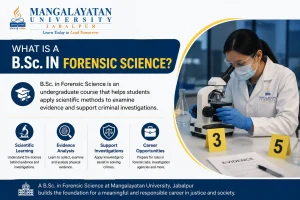
What Is a B.Sc. in Forensic Science?
B.Sc. Forensic Science is an undergraduate science program that teaches you how scientific principles are applied to the examination of evidence. Instead of focusing only on the investigation of a crime, you learn how evidence can be scientifically examined and interpreted. Depending on the university, the curriculum can include forensic biology, forensic chemistry, toxicology, fingerprint analysis, questioned documents, criminology, forensic psychology, cyber forensics, and crime-scene management.
At Mangalayatan University, Jabalpur, the B.Sc. Forensic Science program covers areas such as forensic biology, forensic chemistry, toxicology, fingerprint analysis, questioned documents, forensic psychology, criminology, cyber and digital forensics, and crime-scene management. This multidisciplinary structure allows you to understand how different branches of science contribute to forensic investigation.
Why Is Forensic Science Becoming Important in India?
The nature of investigation is changing. Modern cases can involve biological samples, DNA, drugs, chemicals, fingerprints, electronic devices, financial records, and digital information. Consequently, forensic laboratories need professionals who understand scientific evidence and can work with specialized analytical methods.
Government investment also reflects the growing importance of forensic infrastructure. Under NFIES, ₹2,254.43 crore has been approved to strengthen forensic facilities and human resources. However, this should not be interpreted as a guarantee of employment. Your career will still depend on your qualifications, specialization, skills, recruitment requirements, and performance.
B.Sc. Forensic Science Colleges in MP
Madhya Pradesh has several universities and institutions offering forensic science-related programs. When you compare B.Sc. forensic science colleges in Madhya Pradesh, do not select a college only because it appears in a ranking or advertisement. We recommend that you compare the curriculum, laboratory facilities, practical exposure, faculty, internships, research opportunities, fees, career support, and university recognition.
For a practical course such as forensic science, laboratory exposure is particularly important. You should ask whether students receive opportunities to perform experiments, examine samples, understand analytical instruments, and participate in practical or simulated investigation activities.
Important factors to compare:
- University recognition and program status
- Practical laboratory facilities
- Course curriculum
- Faculty qualifications
- Internship opportunities
- Research exposure
- Industry interaction
- Placement/career assistance
- Total course cost
- Hostel and campus facilities
B.Sc. Forensic Science Course in MP: Duration
The duration of a B.Sc. in Forensic Science depends on the university and program structure. At Mangalayatan University, Jabalpur, the B.Sc. Forensic Science program is currently structured as a three-year undergraduate program divided into six semesters. It provides students with a foundation in forensic science while introducing them to scientific, investigative, and technological applications.
B.Sc. Forensic Science Eligibility
B.Sc. Forensic Science eligibility varies from one university to another, so you should always check the latest admission notification before applying. At Mangalayatan University, Jabalpur, the current admission information requires students to have completed 10+2 with PCM/PCB from a recognized board, subject to the university’s applicable requirements.
If you are currently studying Class 12 in the science stream, you can start researching universities early. This gives you time to compare programs, fees, admission procedures, and career opportunities instead of choosing a college at the last moment.
B.Sc. Forensic Science Admission in MP 2026
If you are planning B.Sc. Forensic Science admission in MP 2026, begin by checking eligibility and shortlisting universities. Read the official program information carefully because admission criteria, fees, and procedures can change.
A simple approach is the following:
Check eligibility → Compare colleges → Check curriculum → Compare fees → Understand admission process → Apply → Complete admission formalities
At Mangalayatan University, Jabalpur, B.Sc. Forensic Science is among the programs offered for undergraduate study. Students should verify the latest admission dates, eligibility, and fee information directly with the university before applying.

B.Sc. Forensic Science Fees in MP
The B.Sc. Forensic Science fees in MP can vary significantly between government, private, and other institutions. Your actual cost may include tuition, examination, registration, laboratory, and other institutional charges. Hostel, transportation, and living expenses may be separate.
Therefore, do not compare colleges only on the basis of the advertised tuition fee. Ask for the complete fee structure and understand what is included. At Mangalayatan University, Jabalpur, prospective students should check the latest official fee schedule because fee information can be revised.
Before paying your admission fee, check:
- Tuition fee
- Examination charges
- Registration/admission charges
- Laboratory-related charges
- Hostel charges, if applicable
- Scholarship availability
- Refund policy
What Do You Learn in B.Sc. Forensic Science?
One of the biggest advantages of studying forensic science is its multidisciplinary nature. You can study scientific subjects while also learning how evidence is connected with investigation.
At MUJ, key areas include forensic biology, forensic chemistry, forensic toxicology, fingerprint analysis, questioned documents, forensic psychology, criminology, cyber and digital forensics, crime-scene management, and analytical techniques.
For example, forensic biology can help you understand biological evidence, while forensic chemistry introduces you to the examination of substances. Toxicology deals with drugs and poisons, whereas digital forensics focuses on evidence from digital environments. This combination allows you to develop a broader understanding of forensic investigation.
Why Practical Learning Matters
You cannot become confident in forensic science through textbooks alone. A major part of professional competence comes from understanding how scientific procedures are performed.
We encourage you to look for a university where practical learning is integrated into the program. Laboratory sessions, practical workshops, mock investigations, and project work can help you connect classroom concepts with real-world applications.
This is particularly important because forensic work requires accuracy, documentation, attention to detail, and scientific reasoning.
Skills You Can Develop
A B.Sc. Forensic Science program can help you develop analytical and professional skills that are useful across scientific and investigative careers.
The most important skills include:
- Scientific reasoning
- Analytical thinking
- Observation and attention to detail
- Laboratory techniques
- Evidence documentation
- Research skills
- Problem-solving
- Communication
- Ethical decision-making
- Digital and technological awareness
These skills can also support you if you later move into research, higher education, or related scientific fields.
B.Sc. Forensic Science Career Options
One of the most common questions students ask is, “What can I do after a B.Sc. in Forensic Science?”
Your career options depend on your qualifications, specialization, experience, and recruitment requirements. Potential career areas include forensic laboratories, crime-scene investigation, forensic biology, toxicology, fingerprint analysis, document examination, digital forensics, research, and scientific assistance.
Possible roles may include forensic scientist, forensic laboratory analyst, crime scene investigator, forensic biology analyst, toxicology assistant, fingerprint analyst, digital forensic analyst, research assistant, and scientific assistant.
However, you should remember that a B.Sc. degree does not automatically guarantee a particular government position. Government forensic jobs generally involve specific eligibility criteria and recruitment procedures.
Government and Private Career Opportunities
After graduation, you can explore opportunities in government forensic laboratories, police and investigation-related organizations, private forensic laboratories, research institutions, cybersecurity and digital forensics organizations, and pharmaceutical and analytical laboratories, depending on your specialization and eligibility.
If you are interested in government employment, you should regularly monitor official recruitment notifications because eligibility, examinations, and selection procedures vary by organization and position.
Digital Forensics: An Emerging Area
Forensic science is no longer limited to fingerprints and biological samples. Digital evidence has become increasingly relevant in investigations involving computers, mobile devices, and other electronic systems.
This makes cyber and digital forensics an attractive area for students who enjoy both science and technology. If you are interested in this field, you can strengthen your profile by developing relevant computer, cybersecurity, and digital-investigation skills alongside your core forensic science education.
Is B.Sc. Forensic Science a Good Career Option?
It can be a good option if you genuinely enjoy science, investigation, laboratory work, technology, and analytical problem-solving.
But you should not choose the course simply because crime-related careers appear interesting in films or television. Real forensic science involves laboratory procedures, scientific documentation, careful analysis, patience, and professional ethics.
You should be comfortable with subjects such as biology and chemistry and should enjoy working with evidence systematically.
Forensic science may suit you if:
- You enjoy science and laboratory work.
- You are interested in investigation.
- You have strong attention to detail.
- You enjoy analytical problem-solving.
- You are interested in technology and evidence.
- You are willing to pursue higher education or specialized training.
Higher Studies After B.Sc. Forensic Science
Your bachelor’s degree can be the beginning rather than the end of your forensic education. If you want advanced knowledge or research-oriented opportunities, you can consider an M.Sc. in Forensic Science after graduation.
Mangalayatan University, Jabalpur, also offers an M.Sc. Forensic Science program, allowing students to continue in the same broad discipline. Depending on your interests, you can also explore specialized areas such as cyber forensics, criminology, forensic toxicology, forensic biology, or research.
Students interested in academics and research can consider doctoral-level education after completing the relevant postgraduate qualifications.
Why Choose Mangalayatan University, Jabalpur?
When you compare B.Sc. Forensic Science Colleges in MP, you should look at the complete academic ecosystem rather than only fees or advertisements.
Mangalayatan University, Jabalpur, offers B.Sc. Forensic Science through its Department of Forensic Science. The program combines scientific concepts with forensic applications and includes areas such as biology, chemistry, toxicology, fingerprinting, cyber forensics, and crime-scene management.
We believe you should have opportunities to learn through both theory and practical exposure. MUJ’s science and forensic science academic information highlights laboratory-based learning, practical activities, and an industry-oriented approach.
The university also provides students with access to campus learning facilities and career-development support.
How to Choose the Best B.Sc. Forensic Science College in MP
There is no single college that is automatically “best” for every student. Your choice should depend on what you need from your university.
Before taking admission, check:
- Curriculum: Does it include modern forensic subjects?
- Laboratories: Are practical facilities available?
- Faculty: Do teachers have relevant academic expertise?
- Fees: What is the complete cost?
- Practical Exposure: Are internships, projects, or workshops available?
- Career Support: Does the university provide placement or career guidance?
- Higher Studies: Can you continue with postgraduate education?
- Recognition: Is the institution and program appropriately recognized?
Conclusion
Choosing among B.Sc. Forensic Science colleges in MP requires more than comparing fees or searching for the nearest college. You are choosing an academic foundation for a specialized field that combines science, investigation, technology, and evidence analysis.
India’s investment in forensic infrastructure shows that the field is receiving increasing institutional attention. At the same time, your success will depend on the skills you build, the practical experience you gain, and the effort you put into your education.
If you are planning B.Sc. Forensic Science admission in MP 2026, compare your options carefully. Look at the curriculum, laboratories, faculty, fees, practical exposure, and career support.
At Mangalayatan University, Jabalpur, we aim to help you build a strong foundation in forensic science through academic learning and practical exposure. If you have the curiosity to ask questions, the patience to analyze evidence, and the interest to understand how science supports investigation, B.Sc. Forensic Science could be the right starting point for your career.
Frequently Asked Questions
What is a B.Sc. in Forensic Science?
B.Sc. Forensic Science is an undergraduate science program that applies scientific principles to the examination and interpretation of evidence.
What are the B.Sc. Forensic Science eligibility requirements?
Eligibility varies by university. At Mangalayatan University, Jabalpur, students currently require 10+2 with PCM/PCB from a recognized board, subject to the university’s applicable admission requirements.
What is the duration of a B.Sc. in Forensic Science?
At Mangalayatan University, Jabalpur, the program is currently three years and six semesters.
What are the B.Sc. Forensic Science career options?
Career areas can include forensic laboratories, crime-scene investigation, forensic biology, toxicology, fingerprint analysis, digital forensics, research, and scientific assistance.
Is a B.Sc. in Forensic Science good after 12th?
It can be a suitable option for science students interested in investigation, laboratory work, evidence analysis, and technology.
Is forensic science in demand in India?
India is strengthening its forensic infrastructure, including through the NFIES, which has a ₹2,254.43 crore approved outlay and aims to address shortages of trained forensic professionals.
Can I do an M.Sc. after a B.Sc. in Forensic Science?
Yes. You can pursue postgraduate study such as an M.Sc. in Forensic Science, subject to the eligibility criteria of the university you choose.