Future Skills Every Student Needs in the Age of AI
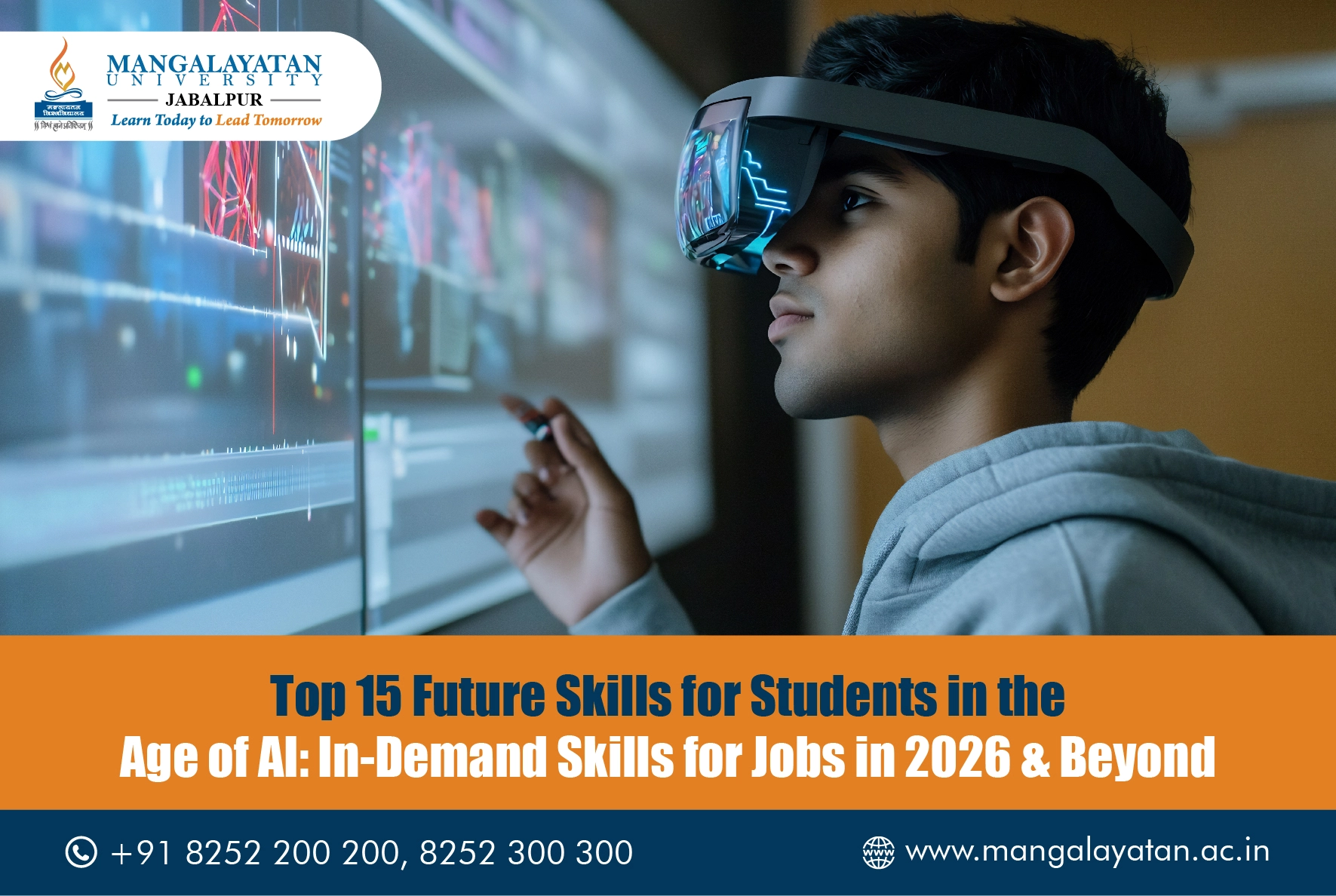
Top 15 Future Skills Every Student Should Learn in the Age of AI
What will your career look like five years from now? It is a difficult question because the workplace is changing rapidly. Artificial intelligence, automation, data analytics, cybersecurity, cloud computing, and other technologies are transforming how organizations operate and how professionals perform their jobs.
For you as a student, this creates both a challenge and an opportunity. The challenge is that a degree alone may not be enough to differentiate you in an increasingly competitive employment market. The opportunity is that you can start developing relevant skills while you are still in college.
So, what are the best future skills for students? Should you learn AI? Coding? Data analytics? Communication? Leadership? Creativity? The better approach is not to choose only one. You need a combination of technical, professional, and human skills.
The World Economic Forum’s Future of Jobs Report 2025 estimates that 39% of workers’ existing skill sets could be transformed or become outdated between 2025 and 2030. The report identifies AI and big data, networks and cybersecurity, and technological literacy among the fastest-growing skills, while analytical thinking, creativity, resilience, and leadership continue to be important.
This means your career preparation should begin before graduation. At Mangalayatan University, Jabalpur, we understand that today’s students are preparing for an employment landscape where technology and professional expectations are constantly evolving. The university offers programs across technology, management, agriculture, science, commerce, law, pharmacy, physiotherapy, and other disciplines, giving students opportunities to pursue different career pathways.
Let’s explore the skills that can help you become more future-ready.
1. Artificial Intelligence and AI Literacy
Let’s ask the most obvious question:
Do you need to become an AI engineer? Not necessarily. But should you understand artificial intelligence? Increasingly, yes. AI literacy means understanding how AI tools work at a basic level, what they can do, their limitations, and how they can be used responsibly.
You can learn about:
- Generative AI
- Large language models
- AI assistants
- Prompting
- Automation
- AI ethics
- Data privacy
- AI applications
Students pursuing technology-oriented programs such as B.Tech CSE, BCA, or MCA at Mangalayatan University, Jabalpur, can build deeper technical knowledge, while students from management, commerce, agriculture, or other disciplines can learn how AI applies to their respective fields. MUJ currently offers B.Tech CSE and computer application programs, including BCA and MCA. The important point is simple: AI should become a tool you understand rather than a technology you fear.
2. Data Literacy and Analytics
How do modern organizations make decisions? Increasingly, they rely on data. Businesses study customer behavior. Banks analyze financial information. Agricultural professionals examine crop and weather data. Healthcare organizations work with digital records. Data literacy allows you to understand information and turn it into useful insights.
You can begin by learning:
- Spreadsheets
- Basic statistics
- Data interpretation
- Charts
- Dashboards
- Data visualization
If you want to go further, you can explore SQL, Python, machine learning, and advanced analytics. For students interested in management and data-driven careers, an MBA in Business Intelligence & Data Analytics at Mangalayatan University, Jabalpur, is particularly relevant. The university currently lists this as a two-year postgraduate program for graduates. So, when you think about skills to learn in 2026, don’t overlook data.
3. Cybersecurity
What happens when almost every organization depends on digital systems?
Protecting those systems becomes essential.
Cybersecurity professionals help protect networks, applications, information, and digital infrastructure.
The World Economic Forum identifies networks and cybersecurity among the fastest-growing skills.
If you are interested in computing, you can explore areas such as the following:
- Network security
- Ethical hacking
- Cloud security
- Digital forensics
- Information security
Students entering B.Tech CSE, BCA, or MCA can build a foundation for technology-related careers and later specialize according to their interests.

4. Technological Literacy
You don’t need to know every technology. But you should be comfortable with the digital tools relevant to your profession.
Technological literacy may involve understanding:
- Cloud platforms
- Digital collaboration
- AI tools
- Automation
- Productivity software
- Digital communication
The WEF identifies technological literacy as one of the skills increasing in importance. Whether you choose BBA, B.Com, B.Sc. IT, BCA, or B.Tech CSE, technology can increasingly become part of your professional environment. MUJ’s Department of Science currently offers B.Sc. (Hons.) Information Technology and M.Sc. IT, providing another pathway for students interested in technology and IT-enabled careers.
5. Analytical Thinking
AI can produce an answer. But can you judge whether it is correct? That is where analytical thinking matters. Analytical thinking helps you evaluate evidence, identify relationships, and make logical decisions. The WEF identifies analytical thinking as one of the most important core skills for employers.
You can develop it through:
- Case studies
- Research
- Data analysis
- Problem-solving
- Debates
- Projects
This skill is valuable whether you eventually become an engineer, manager, lawyer, agriculture professional, or scientist.
6. Creative Thinking
AI can generate content quickly. So, does creativity become less important? No. When technology gives everyone access to similar tools, original thinking can become an important differentiator.
Creative thinking helps you:
- Generate ideas
- Find new approaches
- Develop solutions
- Identify opportunities
- Think beyond conventional answers
A management student can use creativity to develop a business concept. A technology student can design a new application. An agriculture student can explore innovative farming solutions. The WEF also identifies creative thinking as a growing skill area.
7. Communication Skills
Can you explain your idea clearly? Can you present your project confidently? Can you write professionally? Technology cannot eliminate the need for effective human communication.
You should develop:
- Writing
- Speaking
- Presentation
- Active listening
- Negotiation
- Professional communication
This is especially valuable for students pursuing programs such as BBA, MBA, B.Com, BA, or law, where communication can directly influence professional effectiveness.
8. Adaptability
What if the technology you learn today changes tomorrow? You learn again. Adaptability means being willing to change your approach, acquire new skills, and work in unfamiliar situations. The WEF highlights resilience, flexibility, and agility among skills expected to grow in importance. Your first job may not be your final career. Your ability to adapt can help you navigate that journey.
9. Emotional Intelligence
Workplaces are made up of people. Emotional intelligence helps you understand your emotions, communicate effectively, and respond appropriately to others.
It involves:
- Empathy
- Self-awareness
- Listening
- Conflict management
- Relationship building
A technically capable professional who can also work well with people can become a valuable member of a team.
10. Leadership
Leadership doesn’t begin when you become a manager.
You can practice it as a student. Lead a project. Organize an event. Coordinate a team. Take responsibility. The WEF identifies leadership and social influence among important future skills.
Students pursuing management programs such as BBA and MBA at MUJ can particularly benefit from developing leadership, decision-making, and organizational abilities alongside their academic knowledge.
11. Collaboration
Can you work with someone who thinks differently from you? Future projects are likely to involve multidisciplinary teams. A technology project might involve developers, designers, business professionals, and cybersecurity specialists. An agricultural technology project may bring together agriculture specialists, data professionals, and entrepreneurs. Collaboration teaches you to listen, contribute, negotiate, and work towards a shared objective.
12. Problem-Solving
Employers need people who can solve problems rather than simply follow instructions.
Suppose a company says:
“Our sales have declined. Find out why.”
You need to research the situation, analyze evidence, identify possible causes, and recommend a solution. AI can assist you. But you still need human judgment. Problem-solving therefore remains one of the most valuable employability skills.
13. Strategic Thinking
Strategic thinking means considering the bigger picture.
Instead of asking:
“What should I do today?”
You ask:
“What should I do today to achieve the desired result tomorrow?” This matters in business, management, technology, entrepreneurship, and leadership. Students can develop this ability through case studies, business competitions, projects, and long-term planning.
14. Responsible AI and Digital Ethics
Knowing how to use AI is not enough. You also need to know how to use it responsibly.
Ask:
Should confidential information be entered into an AI tool? How do you verify AI-generated information? What about plagiarism and copyright? What happens if an algorithm is biased? Responsible AI use requires awareness of privacy, intellectual property, accuracy, fairness, and academic integrity. The future professional must understand both what technology can do and what it should do.
15. Curiosity and Lifelong Learning
What happens when your industry changes? You learn. Curiosity encourages you to ask questions, explore unfamiliar subjects, and continue developing your capabilities. The WEF identifies curiosity and lifelong learning among skills expected to rise in importance. Your degree provides a foundation. Your willingness to learn keeps that foundation relevant.
The Bigger Picture
The future is not about choosing between technology and human skills. It is about combining them.
- AI + data + technology + analytical thinking + creativity + communication + adaptability + leadership
This combination can help you become more resilient as the job market changes. But knowing these skills isn’t enough.
The next question is:
How can you develop them while studying, and which MUJ program can help you build the right academic foundation?

How to Build Future Skills and Choose the Right Career Path
Knowing the future skills in demand is only the beginning. You now need to convert those skills into actual capabilities.
- A certificate can show that you completed a course.
- A project can show that you applied your knowledge.
- An internship can show that you experienced a professional environment.
- A strong academic program can give you the foundation to develop all three.
So, how should you prepare?
Build a Skill Stack Around Your Degree
You don’t need to master every emerging technology.
Instead, build a combination that complements your chosen discipline.
If You Love Technology
Consider building:
Programming + AI + Data + Cybersecurity + Communication
For this pathway, B.Tech CSE, BCA, MCA, and B.Sc. IT at Mangalayatan University, Jabalpur, can provide relevant academic routes. MUJ’s engineering department describes its technical programs as combining theoretical learning with practical experience, laboratory work, industry-oriented projects, and internships.
If You Want a Career in Business
Build:
- Business Knowledge + Analytics + AI + Communication + Leadership
You can explore a BBA or MBA at MUJ. For graduates particularly interested in data-driven management, MUJ also lists an MBA in Business Intelligence & Data Analytics.
If You Are Interested in Agriculture
Agriculture is also becoming increasingly technology-driven. Modern agriculture can involve data, mechanization, precision practices, environmental monitoring, and entrepreneurship. If this interests you, B.Sc. (Hons.) Agriculture, B.Sc. (Hons.) Horticulture, B.Sc. (Hons.) Forestry, and related postgraduate agriculture programs at MUJ can provide an academic foundation for agriculture-related careers.
If You Want to Combine Commerce With Digital Skills
Financial and business decisions increasingly rely on technology and data. Students can consider B.Com or M.Com at MUJ while developing additional skills in analytics, financial technology, communication, and digital tools.
If You Are Interested in Science and Investigation
Technology is also transforming scientific and forensic work. MUJ offers B.Sc. Forensic Science and M.Sc. Forensic Science, alongside Information Technology programs. The broader lesson is Choose a degree that gives you subject expertise, then add future-facing skills around it.
Build Projects, Not Just Certificates
Here’s a question worth asking:
What can you show an employer?
- If you say you know data analytics, can you show a dashboard?
- If you say you know programming, can you demonstrate an application?
- If you say you understand business, can you present a business plan?
- If you say you’re interested in agriculture technology, can you explain a project?
Projects turn theoretical knowledge into evidence.
Follow this cycle:
- Identify a problem → Research → Build → Test → Improve
That experience can be more meaningful than simply collecting certificates.
Get Industry and Practical Exposure
Can you understand an entire profession from textbooks? Probably not. Practical exposure can help you understand deadlines, teamwork, workplace communication, and professional expectations. MUJ’s engineering department specifically highlights practical learning, internships, and industry-driven projects as part of its technical education approach.
As a student, look for opportunities to participate in:
- Internships
- Workshops
- Projects
- Competitions
- Seminars
- Industry interactions
- Research activities
Every experience can teach you something.
Develop a Professional Portfolio
Your résumé says what you studied.
Your portfolio demonstrates what you can do.
Depending on your field, you could include the following:
- Academic projects
- Research
- Coding projects
- Articles
- Presentations
- Designs
- Business plans
- Data dashboards
- Case studies
Start during your first year rather than waiting until graduation.
By the time you apply for your first job, you should ideally have evidence supporting your skills.
Learn to Communicate Your Knowledge
Imagine that you have completed an impressive technical project.
An interviewer asks:
“Explain it to someone who doesn’t understand the technology.”
Can you?
Practice communicating complex ideas simply.
Participate in:
- Presentations
- Debates
- Group discussions
- Seminars
- Competitions
- Student activities
Your knowledge creates potential.
Your ability to communicate it helps others recognize that potential.
Explore Interdisciplinary Careers
Some of tomorrow’s opportunities may exist between traditional disciplines.
Think about:
- AI + Agriculture
- Data + Finance
- Technology + Healthcare
- Cybersecurity + Law
- AI + Marketing
- Technology + Education
This is why you should not limit your learning to one textbook or department. Attend events outside your discipline. Talk to students from other programs. Explore industries. You may discover a career combination you had never considered.
Develop Entrepreneurship Skills
Do you need to work for an organization to build a successful career?
Not necessarily.
Entrepreneurship can teach you how to identify problems and turn ideas into solutions.
It develops:
- Opportunity recognition
- Market research
- Financial awareness
- Decision-making
- Risk management
- Customer understanding
- Leadership
Even if you eventually join a company, entrepreneurial thinking can help you become someone who looks for opportunities rather than waiting for instructions.
Build Your Digital Professional Identity
Before applying for jobs, ask:
What will an employer find if they search my name online?
Consider creating:
- A professional LinkedIn profile
- An online portfolio
- GitHub for technical work
- Published articles
- Research contributions
You don’t need to become a social media celebrity.
You need to create a credible professional identity.
Learn From Failure
- Your career will not be perfect.
- You may fail an interview.
- A project may not work.
- An internship may not match your expectations.
- You may discover that a particular career isn’t right for you.
These experiences can provide valuable information.
The important thing is to learn, adjust, and continue.
Resilience is not avoiding failure. It is knowing how to move forward after it.
Create a Personal Learning Roadmap
You don’t have to learn everything immediately.
First Year: Explore
Build:
- Communication
- Digital literacy
- AI awareness
- Time management
- Basic professional skills
Second Year: Apply
Focus on:
- Projects
- Internships
- Competitions
- Research
- Portfolio building
Final Year: Specialize
Identify your strongest career direction.
Then deepen the relevant skills.
For example:
- Tech CSE → AI/Data/Cybersecurity
- BBA → Analytics/Marketing/Finance/Entrepreneurship
- Com → Finance/Analytics/FinTech
- Sc. Agriculture → Agri-technology/Research/Entrepreneurship
This approach allows your degree and future skills to reinforce each other.
Why Choose Mangalayatan University, Jabalpur, for Your Future-Ready Education?
Choosing a university is an important decision. You are not simply choosing where to study for the next few years. You are choosing the academic environment in which you will develop your knowledge, skills, and professional identity. Mangalayatan University, Jabalpur, offers programs across multiple disciplines, including engineering and technology, management, computer applications, agriculture, science, commerce, law, pharmacy, and allied areas.
The university states that its programs emphasize practical learning, research, industry relevance, innovation, and entrepreneurship, depending on the discipline. This makes MUJ relevant for students who want to build both academic knowledge and future-oriented capabilities. If your goal is technology, explore B.Tech CSE, BCA, MCA, or B.Sc. IT.
If you want business and management, explore a BBA, MBA, or MBA in Business Intelligence & Data Analytics. If agriculture interests you, consider B.Sc. (Hons.) Agriculture, Horticulture, Forestry, and postgraduate agriculture programs.
If you want commerce, explore B.Com or M.Com. If science interests you, MUJ offers programs including B.Sc. Forensic Science and B.Sc. IT. And if your career interest lies in law, pharmacy, physiotherapy, or other disciplines, MUJ has programs across those areas as well. The right course is the one that connects your interests with the skills and knowledge your desired career requires.
The Future Is Not Humans Versus AI
Will AI change jobs? Yes. Will some tasks become automated? Yes. But does that mean there will be no opportunities for students? Absolutely not. The WEF’s research actually points towards a changing labor market in which both new opportunities and displaced roles are expected. The bigger change is what employers expect from people.
- AI can process information.
- You provide judgment.
- AI can automate repetitive tasks.
- You define priorities.
- AI can generate ideas.
- You evaluate them.
- AI can identify patterns.
- You determine what they mean.
Therefore, the future professional needs both technology and human capability.
Conclusion: Start Building Your Future Today
The most important question isn’t”What job will exist in 2030?”
We cannot predict every job with certainty.
A better question is
“Will I have the skills to adapt when the job market changes?”
If the answer is yes, you are already moving in the right direction.
- Build strong knowledge.
- Learn relevant technology.
- Understand AI.
- Develop data literacy.
- Communicate clearly.
- Think critically.
- Create projects.
- Gain practical exposure.
- Stay curious.
At Mangalayatan University, Jabalpur, you can choose an academic pathway aligned with your interests while developing the future skills that can complement your degree. With programs spanning technology, management, agriculture, science, commerce, law, and other professional areas, MUJ provides multiple routes for students planning their higher-education journey.
Admissions for the 2026–27 session are open, according to the university’s current admission information. So, if you are planning your next academic step, don’t wait for the future to arrive. Choose your field. Build your skills. Create your experience. And prepare yourself to grow with the future—not simply react to it.